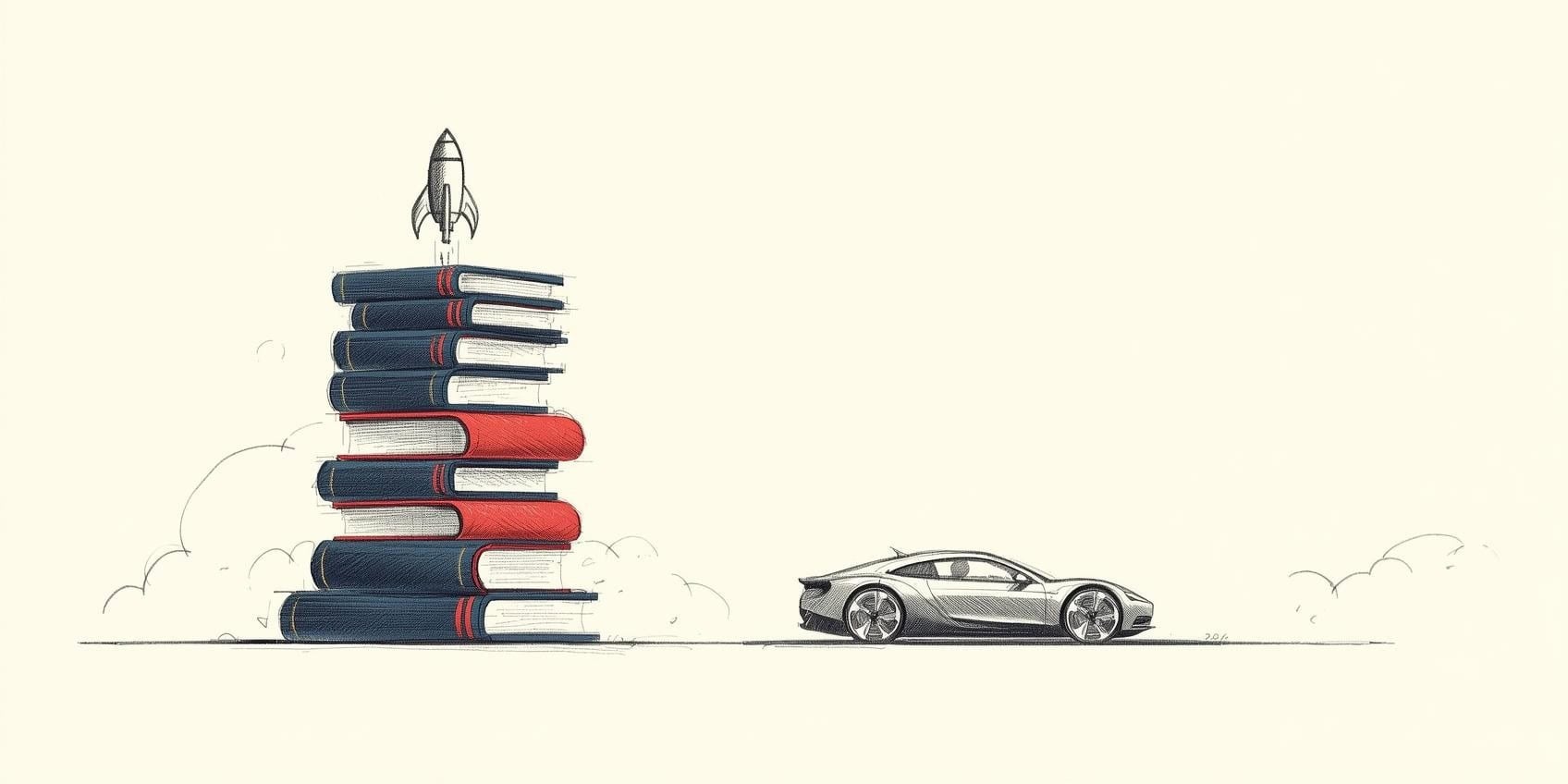
Elon Musk has spoken often about how much books shaped his early thinking. In a 2009 profile in The New Yorker, he described reading as his main escape from a difficult childhood in Pretoria, South Africa. He spent most of his free time absorbed in science fiction and fantasy, and those stories helped define how he thinks about technology, innovation, and the future.
Over the years, Musk has mentioned dozens of books across interviews, public talks, and tweets. For this guide, I gathered every recommendation from reliable, publicly available sources through November of 2025. Every book listed below includes a reference to where Musk recommended it.
- Science Fiction Recommended by Elon Musk
- Artificial Intelligence Books Recommended by Elon Musk
- Business and Economics Books Recommended by Elon Musk
- Biographies Recommended by Elon Musk
- History Books Recommended by Elon Musk
- Fiction Recommended by Elon Musk
- Other Nonfiction Recommended by Elon Musk
Science Fiction Recommended by Elon Musk
The Machine Stops
Author: E.M. Forster
First published: 1909
Recommended by Musk here.
This classic short story describes a society in which humans no longer live on the surface of the earth, but in individual, subterranean rooms where all their needs are met by the all-powerful, deified Machine.
Travel is rare, and people communicate via videoconferencing to share ideas. As the Machine breaks down, society starts to crumble with it.
In light of the recent lockdowns, travel restrictions, and reliance on internet communication due to COVID-19, this piece is nothing short of prophetic.
The Foundation Series
Author: Isaac Asimov
First published: 1942
Recommended by Musk here.
In this award-winning novel series from foundational sci-fi author Asimov, mathematician Hari Seldon predicts the inevitable fall of the Galactic Empire and a Dark Age that will last 30,000 years.
In an attempt to reduce the crisis to a mere millennium, Seldon establishes two “Foundations” to preserve scientific knowledge and human civilization.
There are a total of seven books in the series, with the final edition being published in 1993. However, the first three books — usually referred to as The Foundation Trilogy — are widely considered the most important.
Stranger in a Strange Land
Author: Robert Heinlein
First published: 1961
Recommended by Musk in a now-deleted AdWeek interview.
Mike, a human born on Mars and raised by Martians, returns to earth after World War III. Although he is technically returning home, human society is strange and unknown to him.
He has ownership claims to Mars, and nurse Jill Boardman helps him escape the government whom she fears could harm him. He then starts a new religion based on Martian philosophy.
Dune
Author: Frank Herbert
First published: 1965
Recommended by Musk here.
The planet Arrakis is a barely inhabitable desert wasteland, and the only source of melange — more commonly referred to as “Spice” — a popular drug that extends life and allows for space navigation.
Dune chronicles the adventures of Paul Atreides and his family as they defend Arrakis from attack and navigate various intergalactic economic, political, religious and military factions.
The Moon Is a Harsh Mistress
Author: Robert Heinlein
First published: 1966
Recommended by Musk here.
The year is 2075, and the moon is a penal colony. Mannie, the son of a convict and an average computer technician, is unwittingly drawn into a revolution for lunar independence.
With the help of a self-aware computer named Mike, Mannie and his fellow moon inhabitants (called Loonies) fight for Earth to recognize the moon as an autonomous state.
I Have No Mouth, and I Must Scream
Author: Harlan Ellison
First published: 1967
Recommended by Musk here.
Computers created by the U.S., the Soviet Union and China have morphed into a supercomputer, called AM, which has become sentient. After nearly completing the elimination of all humans, AM’s only remaining objective is to torture the five remaining humans as revenge for its own existence.
Musk says this story gives him nightmares.
The Hitchhiker’s Guide to the Galaxy
Author: Douglas Adams
First published: 1979
Recommended by Musk here.
Musk says the lighthearted and comical Hitchhiker’s Guide to the Galaxy helped him get through an existential crisis in his teens.
The book follows Arthur Dent, an Earthling who is rescued from Earth’s destruction by Ford Prefect, an alien who hitchhikes his way through the galaxy.
The center screen of the Tesla Roadster Musk launched toward Mars bears a quote from the book: “Don’t panic!”
The Culture Series
Author: Iain M. Banks
First published: 1987
Recommended by Musk here.
All work in “the Culture” — a society of humanoid species, aliens and advanced AI — is performed by machines.
In this post-scarcity utopia, humans have access to anything they want… provided they pledge allegiance to “the Minds” that control the Culture’s galactic interactions.
Of the 10 works in the series, Musk has specifically mentioned his admiration for The Player of Games (1988), Look to Windward (2000), and Surface Detail (2010).
Dark City
Author: Frank Lauria
First published: 1998
Recommended by Musk here.
In Dark City, even time, memory and truth are malleable. John Murdock wakes up with amnesia and finds himself the suspect of several murders.
Following clues, he uses his psychokinetic powers to attempt to clear his name and evade both police and The Strangers — extraterrestrials who use human bodies as hosts.
Daemon
Author: Daniel Suarez
First published: 2006
Recommended by Musk here.
Brilliant game designer Matthew Sobol is dying of brain cancer and creates a “daemon” to be activated upon his death.
This series of stealthy, interconnected computer programs is designed to seize control of everything — from stock prices to vehicles — in order to create a new world order.
Detective Peter Sebeck must uncover the daemon’s dark purpose and stop it.
Artificial Intelligence Books Recommended by Elon Musk
Our Final Invention
Author: James Barrat
Subtitle: Artificial Intelligence and the End of the Human Era.
First published: 2013
Recommended by Musk here.
Barrat explains that artificial intelligence will someday surpass human intelligence — and argues that that day is coming faster than we think.
His work is accessible and extensive, but cautionary; Barrat warns that while it may seem outlandish to some, super-intelligence could indeed threaten human existence.
Superintelligence
Author: Nick Bostrom
Subtitle: Paths, Dangers, Strategies.
First published: 2014
Recommended by Musk here.
To find out why the risks of AI are so scary, Musk says it’s worth reading Nick Bostrom’s Superintelligence, which makes a daring inquiry into what would happen if computational intelligence surpassed human intelligence.
Unless the superintelligence is endowed with qualities that align with human values, it could become, as Musk puts it, “an immortal dictator from which we could never escape.”
Musk agrees with Bostrom that a superintelligence could be more deadly than nukes.
The AI Revolution
Author: Tim Urban
Subtitle: The Road to Superintelligence.
First published: 2015
Recommended by Musk here.
This two-part blog post explains the historical context for how fast the AI revolution is coming, as well as the technological growth in computing power that our generation will likely witness.
Urban illuminates the tiny corners of our world already quietly running on AI (email spam filters, air traffic control and stock trades, for example) and illustrates the potential — both benevolent and terrible — for the godlike power of AI.
Life 3.0
Author: Max Tegmark
Subtitle: Being Human in the Age of Artificial Intelligence.
First published: 2017
Recommended by Musk here.
Life 3.0 asserts that in order to weather the technological, economic and societal shift brought on by widespread use of artificial intelligence, we must immediately confront some difficult ethical questions.
By proactively planning and shaping our future, we can avoid the disastrous consequences of mismanaged technology after the fact.
Human Compatible
Author: Stuart Russell
Subtitle: Artificial Intelligence and the Problem of Control.
First published: 2019
Recommended by Musk here.
Russell notes that the Machiavellian method of determining the success of an AI task is currently flawed: we look only at how well the task was completed, disregarding (and allowing the computer to disregard) all human values that may be violated in the process.
Similar to Asimov’s Three Laws of Robotics, Russell gives three principles to guide the beneficial development of AI based on human preferences and behaviors.
What We Owe the Future
Author: William MacAskill
First published: 2022
Recommended by Musk here
Musk called What We Owe the Future “worth reading” and said it aligns closely with his philosophy.
In the book, Oxford philosopher William MacAskill explains longtermism, the idea that improving humanity’s long-term future should be a major moral priority. He argues that the choices made today can influence civilization for thousands of years, especially in areas like technology, the environment, and global risks.
Business and Economics Books Recommended by Elon Musk
Screw Business as Usual
Author: Richard Branson
First published: 2011
Subtitle: Turning Capitalism into a Force for Good.
Recommended by Musk here.
The best businesses are the ones with a goal other than increasing their bottom line; ones that make the world a better place for the people in it.
Branson demonstrates this through several case studies, refuting many tenets of traditional capitalism and asserting that “doing good things for society is good for business.”
Zero to One
Author: Peter Thiel and Blake Masters
Subtitle: Notes on Startups, or How to Build the Future.
First published: 2014
Recommended by Musk on the back cover.
In Musk’s own words, “Peter Thiel has built multiple breakthrough companies, and Zero to One shows how.”
Thiel — who was Musk’s partner in co-founding PayPal — describes the modern economic lay of the land and discusses how to find the sweet spot in creating a company that addresses an unmet need in a revolutionary way.
Note: Zero to One also ranks as one of our top books on making money.
The Capitalist Manifesto: Why the Global Free Market Will Save the World by Johan Norberg
Author: Johan Norberg
First published: 2023
Recommended by Musk here
Musk praised The Capitalist Manifesto for its clear defense of free markets and its argument that capitalism has been one of the most powerful forces for reducing poverty and improving human well-being. Norberg explains how open markets, competition, and global trade create innovation, expand opportunity, and lift living standards around the world.
The book also explores common critiques of capitalism and responds with historical evidence showing how market-based systems have consistently outperformed centralized alternatives.
The Road to Serfdom by F. A. Hayek
Author: F. A. Hayek
First published: 1944
Recommended by Musk here
Musk has recommended the audiobook version of The Road to Serfdom, Hayek’s influential work on political economy and individual freedom. The book argues that central planning and government control over economic life can gradually erode personal liberties, even when introduced with good intentions.
Biographies Recommended by Elon Musk
Howard Hughes: His Life and Madness
Author: Donald L. Barlett and James B. Steele
First published: 1979
It’s easy to see why Musk would take an interest in Howard Hughes: he was a business magnate and philanthropist, and he pushed the limits of air travel.
However, in a recent interview with CNN, Musk noted he didn’t want to follow Hughes’ descent into madness, abandoning hygiene and “peeing in jars.”
Benjamin Franklin: An American Life
Author: Walter Isaacson
First published: 2003
Recommended by Musk here.
This biography brings to life the personality and achievements of one of the best known American inventors, scientists, entrepreneurs and statesmen.
Despite Isaacson’s admiration for Benjamin Franklin, he chronicles his flaws as well as his accomplishments.
Musk especially appreciates the rags-to-riches theme of this story, and notes in a CNN interview that Franklin is “one of [his] heroes”.
Einstein: His Life and Universe
Author: Walter Isaacson
First published: 2007
Recommended by Musk here.
This biography encapsulates the brilliant, quirky, non-conformist scientist and his many accomplishments. His childlike wonder and curiosity kept him pursuing the unknown.
The book delves into previously unresearched material to narrate his childhood experiences, struggles, and pursuance of knowledge until his last breath.
Catherine the Great: Portrait of a Woman
Author: Robert Massie
First published: 2011
Recommended by Musk here.
This book delves into the story of Catherine the Great, who started life as Sofia Augusta Fredericka (the daughter of an obscure German noble) and ended up becoming Empress of Russia for over 30 years.
Massie captures both the political and the personal through Catherine’s eyes, giving the reader insight into her brilliant and determined leadership.
Steve Jobs
Author: Walter Isaacson
First published: 2011
Recommended by Musk here.
Unlike his historical biography subjects, Isaacson interviewed Steve Jobs in person and at length for this book. This allowed Isaacson to portray Jobs’ brilliant (albeit dictatorial) leadership of Apple and groundbreaking innovation in all his blunt, feisty splendor.
Steve Jobs was a man who never thought he was wrong — and who, though audacious, usually turned out to be right in the long run.
Genghis Khan and the Making of the Modern World by Jack Weatherford
Author: Jack Weatherford
First published: 2004
Recommended by Musk here
Musk has recommended Weatherford’s biography of Genghis Khan, which reexamines the life of the Mongol leader and the global impact of the empire he built. The book explains how Genghis Khan united diverse tribes, encouraged merit-based leadership, expanded trade networks, and reshaped cultures across Asia and Europe. Weatherford highlights the political, economic, and technological changes that followed the Mongol expansion, offering a more nuanced view of a figure often defined only by conquest.
Masters of Doom by David Kushner
Author: David Kushner
First published: 2003
Recommended by Musk here
Musk has recommended Masters of Doom as a compelling look at two visionary programmers who helped shape modern gaming and computer graphics. The book follows John Carmack and John Romero from their early years as self-taught coders to the creation of id Software and the development of Doom, Quake, and other groundbreaking titles. Kushner explains how their technical breakthroughs, creative rivalry, and intense work ethic transformed video games and influenced broader tech culture.
American Caesar: Douglas MacArthur 1880–1964 by William Manchester
Author: William Manchester
First published: 1978
Recommended by Musk here
Musk has pointed to the American Caesar audibook as a worthwhile biography of one of the most influential military leaders of the twentieth century. In this book, Manchester examines the life of General Douglas MacArthur, covering his early years, his leadership in the Pacific during World War II, and his complex role in the Korean War.
History Books Recommended by Elon Musk
The Story of Civilization by Will and Ariel Durant
Authors: Will Durant and Ariel Durant
First published: 1935 to 1975 (11-volume series)
Recommended by Musk here
Musk has referenced the Durants’ work multiple times, often pointing to their sweeping view of human history and their ability to connect culture, economics, philosophy, and political development across thousands of years. The Story of Civilization is an eleven-volume series that traces the rise and fall of major civilizations, the evolution of ideas, and the lessons history offers for modern society.
The Fifteen Decisive Battles of the World by Edward Creasy
Author: Edward Creasy
First published: 1851
Recommended by Musk here
Musk has mentioned The Fifteen Decisive Battles of the World in a comment where he said, “I hope someone makes an audiobook of The Encyclopedia of Military History by Dupuy and The Fifteen Decisive Battles of the World by Creasy.” Creasy’s book examines fifteen key battles that he believed shaped the course of Western civilization, from Marathon and Hastings to Waterloo.
The Encyclopedia of Military History by R. Ernest Dupuy and Trevor N. Dupuy
Authors: R. Ernest Dupuy and Trevor N. Dupuy
First published: 1970
Recommended by Musk here
Musk has referenced The Encyclopedia of Military History and commented, “I hope someone makes an audiobook of The Encyclopedia of Military History by Dupuy.” The book is a comprehensive reference work that covers thousands of years of military events, major battles, technological developments, and the evolution of warfare from ancient times to the modern era. It is valued for its depth, clear organization, and detailed accounts of how military strategy and tactics have changed throughout history.
Merchants of Doubt
Author: Naomi Oreskes and Erik M. Conway
Subtitle: How a Handful of Scientists Obscured the Truth on Issues from Tobacco Smoke to Global Warming.
First published: 2010
Recommended by Musk here.
Scientists knew that smoking tobacco was dangerous, that acid rain was harmful, and that the climate was changing long before the general public did.
Oreskes and Conway uncover the people and institutions that muddled, changed, and obscured scientific evidence from public view in multiple cases — and what they gained from doing so.
The Age of Napoleon
Author: Will Durant and Ariel Durant
Subtitle: The Story of Civilization.
First published: 1975
Recommended by Musk here.
Somewhere between a history and a biography, The Age of Napoleon covers not only the rise and fall of the French emperor himself, but of the culture of France, the French Revolution, and other key historical players (such as English poets and Beethoven) on the international stage.
Storm of Steel by Ernst Jünger
Author: Ernst Jünger
First published: 1920
Recommended by Musk here
Musk has recommended the audiobook version of Storm of Steel, Jünger’s firsthand account of his experiences as a German soldier during World War I. The book is known for its vivid descriptions of trench warfare, its philosophical reflections on courage and survival, and its unflinching portrayal of the brutality of war.
The Wages of Destruction by Adam Tooze
Author: Adam Tooze
First published: 2006
Recommended by Musk here
Musk has highlighted The Wages of Destruction as a valuable examination of the economic forces behind Nazi Germany’s rise and collapse. Tooze uses detailed economic data to explain how Germany’s limited resources, industrial constraints, and strategic decisions shaped the course of World War II. The book shows how Hitler’s ambitions were ultimately incompatible with the economic realities of the regime, which helps explain both its aggression and its downfall.
The Guns of August by Barbara W. Tuchman
Author: Barbara W. Tuchman
First published: 1962
Recommended by Musk here
Musk has referenced The Guns of August as an important look at the events that led to the outbreak of World War I. Tuchman explains how political misjudgments, rigid military plans, communication failures, and rising tensions pushed Europe into a conflict that few leaders actually wanted. The book focuses on the first month of the war and shows how early decisions shaped the catastrophic years that followed.
The Gallic Wars by Julius Caesar
Author: Julius Caesar
First published: Approx. 50s BC
Recommended by Musk here
Musk has recommended the audiobook version of The Gallic Wars, Caesar’s firsthand account of his military campaigns in Gaul. The work describes battles, strategy, political maneuvering, and Caesar’s perspective on leadership during a period of rapid expansion for Rome. It is valued for its clarity and for the insight it provides into both ancient warfare and Caesar’s own decision making.
Fiction Recommended by Elon Musk
The Lord of the Rings
Author: J.R.R. Tolkien
First published: 1954
Recommended by Musk here.
Musk noted in an interview with the New Yorker that he has admired the unassuming heroes of the books in this epic high-fantasy series since childhood.
Humble hobbits Frodo, Sam, Merry and Pippin journey to unknown lands, team up with dwarves, elves and kings, and fight monsters to save the world from the evil Lord Sauron and the power of the One Ring.
Waiting for Godot
Author: Samuel Beckett
Subtitle: A Tragicomedy in Two Acts.
First published: 1953
Recommended by Musk here.
Musk appreciates the absurd humor of Waiting for Godot, noting that “we so often wait, without knowing why, when or where.”
In this play, two men meet at a scraggly tree to wait for a mysterious Godot, who never arrives. The play is extremely minimalist in props, set and characters, leaving the interpretation very much up to the audience.
The Fault in Our Stars
Author: John Green
First published: 2012
Recommended by Musk here.
Musk admits to enjoying this romantic young adult novel about Hazel, a teenage girl with thyroid cancer who begrudgingly attends a cancer support group to appease her parents.
There, she meets Augustus, a cancer survivor who has lost his leg. Together they travel to Amsterdam to meet Hazel’s favorite author, fall in love, and grapple with loss.
The Iliad (Penguin Edition) by Homer
Author: Homer
First published: Approx. 8th century BC
Recommended by Musk here
Musk has recommended the audiobook version of The Iliad, noting it as a powerful way to experience one of the oldest works in Western literature. The epic recounts the final weeks of the Trojan War and explores themes such as heroism, honor, mortality, and the consequences of pride.
Other Nonfiction Recommended by Elon Musk
Structures
Author: J.E. Gordon
Subtitle: Or Why Things Don’t Fall Down.
First published: 1978
Structures — defined here as any collection of materials, both natural and manmade, that are built to withstand a force or load — are all around us.
This book on structural design and material engineering covers the history of human-designed structures and serves as a primer on the physical principles of building materials (like stress, strain and stiffness).
Gordon gives many practical examples, such as why so many buildings use beams and why broken-in shoes feel nicer than brand-new ones.
If the Universe Is Teeming with Aliens…
Author: Stephen Webb
Subtitle: WHERE IS EVERYBODY?
First published: 2002
Recommended by Musk here.
This book addresses Fermi’s Paradox, which posits the following question: if (statistically) there should be many alien life forms in our universe, why have we found no convincing evidence of them?
With 400 billion stars to host planets in the Milky Way alone, it’s a fair question.
Webb explores dozens of explanations for the paradox — such as that extraterrestrials came and left, they are here but can’t be detected, or that they do not actually exist — weighing in on each theory and concluding with his own ideas on why we haven’t seen any aliens on Earth.
Lying
Author: Sam Harris
First published: 2011
Recommended by Musk here.
The crux of this book is simple: you can make a deep impact by telling the truth when others lie.
Whether the lie is small (telling your wife she doesn’t look fat in that dress) or large (forging tax documents), it usually results in negative consequences for the liar.
Harris examines the psychological and evolutionary precedences for lying, as well as tactical suggestions for telling the painful, scary truth.
A Woman Makes a Plan
Author: Maye Musk
Subtitle: Advice for a Lifetime of Adventure, Beauty, and Success.
First published: 2019
Recommended by Musk here.
Maye Musk’s credentials include international supermodel, registered dietitian, and mother to three successful children — including her son Elon.
Her success and fame have not come easily; she is the survivor of domestic abuse and raised her three children on a small income.
Her advice is simple, yet profound: if you don’t like your situation, environment, or some aspect of yourself, then make a plan to change it. Persevere and work through it, and don’t let age or agencies stop you.
What’s Our Problem? by Tim Urban (2023)
Author: Tim Urban
First published: 2023
Recommended by Musk here
Musk recommended What’s Our Problem? when Tim Urban announced its release in March 2023. Urban — best known for his long-form essays at Wait But Why — takes a step back from day-to-day politics to look at how people think, not what they think.
The book maps out a new framework for understanding today’s chaotic political climate, breaking down concepts like political tribalism, status games, and why society feels increasingly polarized.
The Parasitic Mind by Gad Saad
Author: Gad Saad
First published: 2020
Recommended by Musk here
Musk has praised The Parasitic Mind multiple times, including an August 2025 tweet where he called it a “Great book” while Saad was signing copies. In it, Saad argues that certain irrational “parasitic” ideas — from extreme ideological movements to rigid postmodern frameworks — can hijack human reasoning and spread through culture much like a virus.
Bad Therapy: Why the Kids Aren’t Growing Up by Abigail Shrier
Author: Abigail Shrier
First published: 2024
Recommended by Musk here
Musk publicly endorsed Bad Therapy in March 2024, urging parents to read it.
In the book, Shrier argues that parts of the modern mental health industry may be unintentionally harming Gen Z. She explains how giving kids too much therapy, combined with gentle parenting trends and the widespread use of social-emotional learning programs, can create unintended side effects. These include higher anxiety, lower resilience, and greater emotional dependence.
The Skeptics’ Guide to the Universe by Steven Novella and the SGU Team
Authors: Steven Novella, Bob Novella, Cara Santa Maria, Jay Novella, Evan Bernstein
First published: 2018
Recommended by Musk here
Musk publicly praised The Skeptics’ Guide to the Universe, a book based on the long-running Skeptics’ Guide podcast. The authors present practical tools for critical thinking, scientific reasoning, and evaluating claims in an age where misinformation spreads easily. The book explains common logical fallacies, cognitive biases, and the methods used by science communicators to separate reliable evidence from unsupported ideas.
Twelve Against the Gods
Author: William Bolitho Ryall
Subtitle: The Story of Adventure.
First published: 1929
Recommended by Musk here.
This book is a compilation of 12 seemingly unrelated historical figures, from Christopher Columbus to Muhammad to dancer Isadora Duncan.
What connects this group is the fact that each of these adventurers challenged conformity and the expectations of their day to achieve great heights.
Bolitho defines the adventurer as “an individualist and an egoist, a truant from obligations,” so it’s easy to see why Musk would relate to the people in the book.
Elon Musk Reading List: Final Thoughts
Ironically, in this human era that is oversaturated with information, we often forget how much knowledge can be gained by simply reading a book. Whether or not you want to build rockets and combat climate change, reading like a CEO can help you think like one.
Consistent reading of quality works of fiction and nonfiction alike is well worth the time investment — even if it’s just an escape from the stress of reality. And if a billionaire like Elon Musk has time to read, chances are you do too.
If you enjoy reading the way Musk does, you may also appreciate some of my larger book projects. I’ve compiled the best business books of all time by gathering recommendations from more than 100 entrepreneurs and ranking the titles by how often they were mentioned. I’ve done the same for the best investing books.
I’ve also created individual reading lists pulled directly from the public recommendations of well-known thinkers, including Charlie Munger, Warren Buffett, Howard Marks, Michael Burry, and Nassim Taleb.