

Spending more on a car than you can realistically afford will strain your budget for years. But with a little bit of planning and discipline, you can get the car you want while keeping your payments comfortable.
This step-by-step guide shows you a practical way to evaluate your budget, set a target, automate your savings and regularly review your progress.
An Example of How to Save for a Car
Saving for a car can be broken down into two main approaches: financing a portion of the purchase (i.e., getting an auto loan) or paying for the car entirely in cash.
Here’s an overview of how each method works.
Saving to Buy a Car With a Down Payment
Let’s start with an example of someone who earns $3,500 in monthly take-home pay and is looking to get an auto loan. In this case, they’re saving cash for a down payment, not the full price of a car.
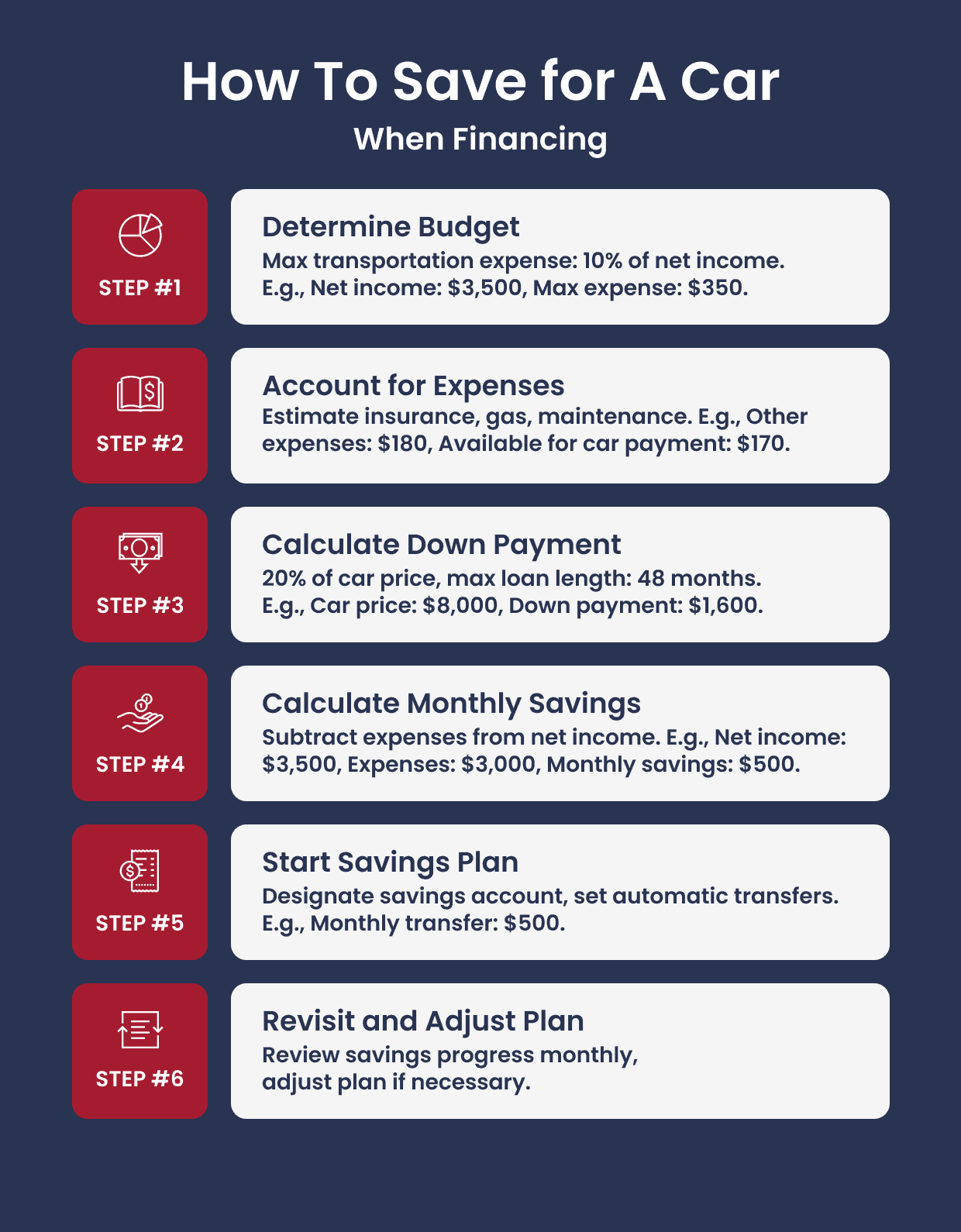
Step 1: Determine how much you want to spend on a car and what you can afford.
A good rule of thumb is that your monthly transportation expenses (including gas and insurance) should be no more than 10% of your net income. In this example, your net income is $3,500, so your maximum transportation expenses are $350 per month.
Step 2: Account for other expenses.
The average cost of minimum-coverage auto insurance is about $60 per month, and the average U.S. driver spends $100 to $200 per month on gas. Maintenance and parking are additional costs that need to be considered. If we stick with the 10% rule mentioned above and estimate $180 in additional transportation expenses a month, that leaves you with a maximum monthly payment of $170.
Step 3: Calculate the down payment amount.
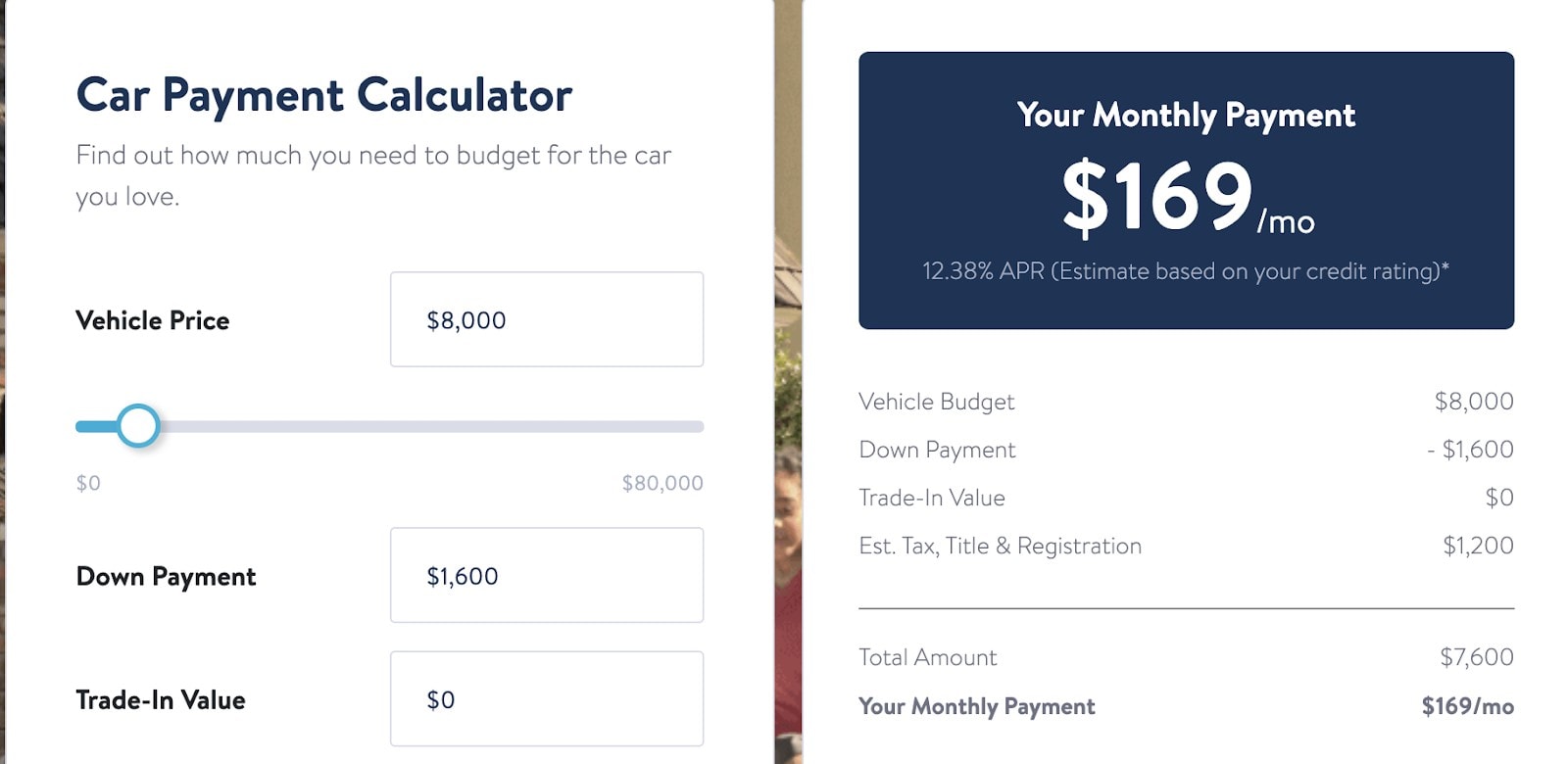
A good rule of thumb for financing a car is to put down 20% of the total purchase price with a maximum loan length of 48 months. With those factors in mind, use an auto loan calculator to determine how much car you can afford based on your maximum monthly payment.
In our example, and using the auto loan calculator linked to above, someone with an average credit score could afford an $8,000 car on $3,500 per-month in after-tax income. This would require a $1,600 down payment, which becomes your savings goal.
Step 4: Calculate how much you can save without making budget cuts.
To get this number, subtract your average monthly expenses from your monthly take-home pay (this is called net income). For example, if your net income is $3,500 and your expenses are $3,000, your maximum possible savings is $500.
Step 5: Start a savings plan towards your car down payment fund.
Designate a specific account to save for your down payment (which is $1,600 in our example), to keep it organized and easily trackable. Then, set up an automatic transfer to this account after your paycheck hits based on your maximum possible monthly savings.
In our example, the maximum figure we’d be able to transfer is $500 per month. But if you have other financial goals, it’s best to reduce this number to account for those other goals (and even to just give yourself a bit of wiggle room).
Say we determine $400 is an acceptable amount to transfer. The next step is to set up an automatic transfer from our checking account to a savings account designated for a car down payment.
Step 6: Revisit and adjust your plan.
Regularly review your savings progress, comparing it with your desired goal every month. If necessary, adjust your plan to accommodate for any changes in your financial situation, ensuring you remain on track and make informed decisions throughout your savings journey.
Saving to Buy a Car In Cash
Now let’s look at an example of someone who earns $3,500 per month in take-home pay and is looking to buy a car with cash, forgoing an auto loan.
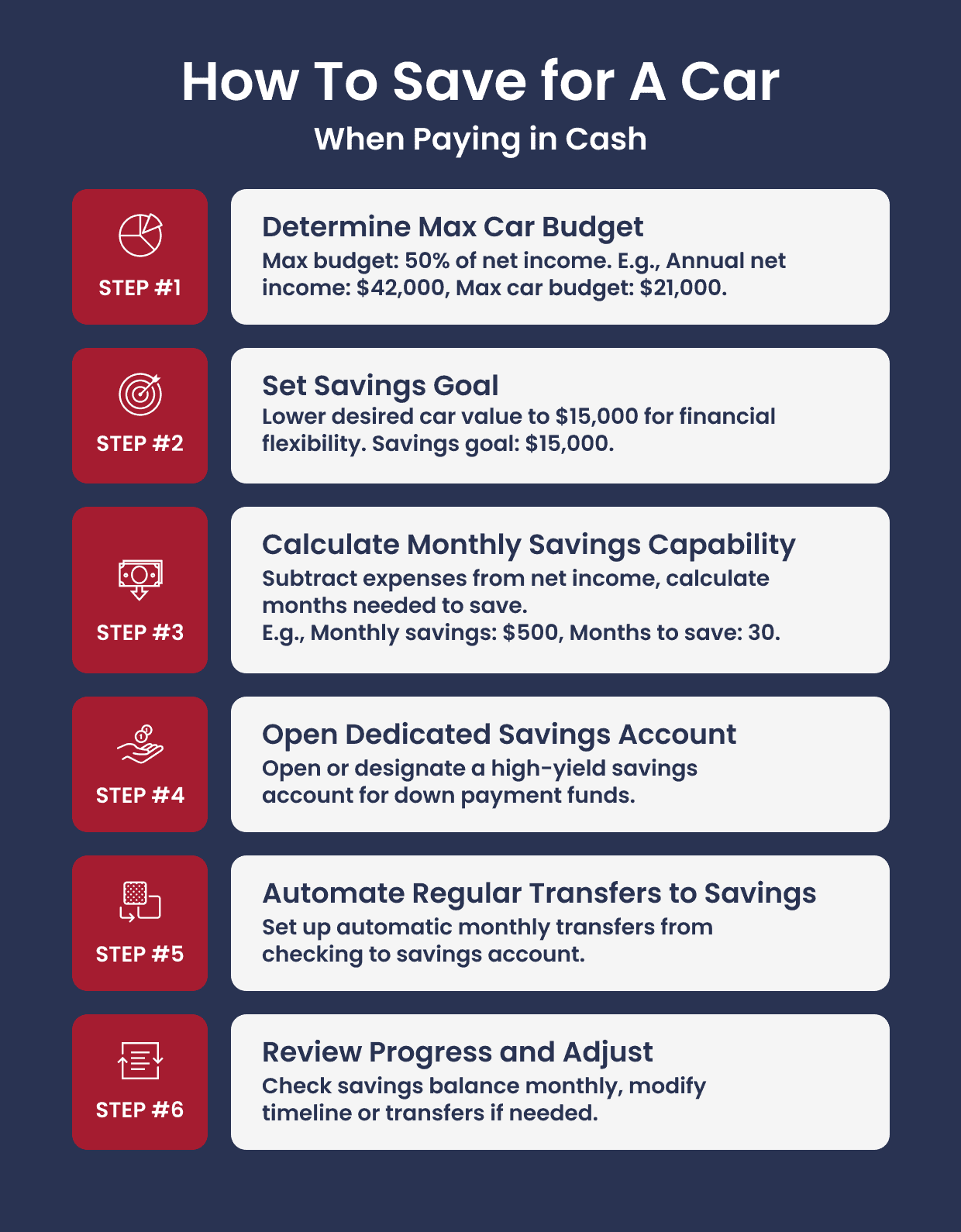
Step 1: Determine your maximum car budget.
A good rule of thumb is that total household vehicle value should be at most 50% of net household income. With a $3,500 monthly net income, which is $42,000 per year, the max car budget would be $21,000.
Note this is the maximum amount you should buy. Your financial situation will impact this amount, especially if you have high-interest debt or will be foregoing 401(k) matching contributions to afford a car.
In other words, just because you can buy this much car doesn’t necessarily mean you should.
Step 2: Set your total savings goal.
While $21,000 is the maximum car budget in our example, let’s lower the desired car value to $15,000 to make room for other financial goals. This $15,000 then becomes your savings goal.
Step 3: Calculate your monthly savings capability.
Subtract your average monthly expenses from your $3,500 take-home pay to see how much you can set aside each month. For example, if your monthly expenses are $3,000, you’d have $500 monthly for car savings, and it would take approximately 30 months to save the desired amount of $15,000.
Step 4: Open a dedicated savings account.
Beyond earning a few dollars in interest, a dedicated savings account provides psychological benefits that make it a must.
More specifically, a separate account earmarked solely for your car down payment does two powerful things:
- It prevents you from dipping into the funds for other expenses. This money is off-limits and reserved only for your goal.
- Watching your car account grow over time motivates you to keep contributing.
Step 5: Automate regular transfers to savings.
Rather than manually transferring funds, set up automatic deposits from each paycheck into savings. This “reverse budgeting” approach shifts money before you can spend it. And overall, it stands as one of the best ways to save money, no matter your goal.
Step 6. Review your progress and adjust.
It’s important to revisit your progress monthly and course correct if needed.
If you’re falling behind your target, take proactive steps to correct course or adjust your timeline.
If you have extra cushion in checking from spending less or earning more, do an additional sweep into your goal account for that month.
Use windfalls like tax refunds or birthday gifts to fast forward your progress.
Paying in Cash vs. Saving for a Down Payment
Debt is often considered a dirty word in personal finance, but taking out an auto loan can work if you follow the steps discussed above.
If you decide to finance a car, I recommend following the 20/4/10 rule:
- Make a down payment of at least 20%.
- The loan length should be four years or less (to limit the total interest you’ll pay).
- Total monthly transportation expenses should be at most 10% of your after-tax income.
Saving up 20% for a down payment is far more than required. Most lenders don’t require a minimum down payment at all. But beyond the benefits of reducing the amount you’ll pay in interest, another benefit of making a down payment is that it forces you to be more conscious about the purchase price.
Car dealerships make it incredibly easy to spend more than you should. You can walk in today and walk out with a loan that will impact your finances for years without giving it much thought.
With average new car prices nearing $50,000, a car loan isn’t a decision that should be made in a high-pressure situation within a dealership.
Forcing yourself to save up for a down payment is a way to think more consciously about how much $50,000 is, as you’ll need to save up 20% ($10,000) to buy that much car. And if you’re unable to do that, chances are you’re stretching yourself too thin on the car purchase price.
The Biggest Mistake People Make When Saving For a Car
The most common mistake people make when saving for a new car is ignoring car ownership costs beyond the monthly payments.
For example, someone sticking to the rule of limiting their car payment to 10% of their monthly take-home pay might determine they can afford a $350 car payment.
But that $350 can easily increase — and perhaps even double — after factoring in insurance, gas, maintenance, parking fees, registration costs, etc.
Fail to budget for these recurring expenses and your transportation costs can creep up to 20% of your income, stretching your budget thin.
The goal is to keep all transportation costs within the 10% monthly net income number.
Tip: Now Is the Time to Start Working On Your Credit
Along with saving up for a car, another smart financial move during this time period is to build or improve your credit score.
In our example, someone with a credit score above 720, compared to an average credit score of between 600 and 659, would lower the monthly payment to $152 from $169. This would save them $17 per month or $816 over four years.
Credit scores take time to build, so starting the process early can save you significant money. More so, when you’re ready to start saving for a house, you’ll be in a much better financial position and can potentially save tens of thousands with a high credit score.
A good first step is using a free app like Credit Karma (see our Credit Karma review), which provides tips for boosting your score that are customized to your credit report.
Some best practices include:
- Pay all your bills on time. Payment history is the biggest factor in your score. Even being a few days late can hurt.
- Keep your credit card balances low. High balances relative to your limit (utilization ratio) drag down your score. A good rule of thumb is to not exceed 30% of your total credit utilization.
- Limit new credit applications. Too many hard inquiries, especially when you’re close to applying for a loan, can ding your score. If you’re looking to apply for a credit card to improve your score, it’s best to do it in the early stages of saving for a car and not when you’re about to apply for a loan.
And if you lack a credit history, it’s important to establish your credit as soon as possible. A good starter credit card is worth looking into at this time.

All your credibility goes when you say no more than 10% for everything. Given that this was written THIS YEAR, you’d think you’d be more in touch with the economy.
Understandable. I looked up the data again. Most households spend around 15% to 17% of their budget on transportation, while many in the finance world recommend aiming for closer to 10%.
Rising costs and personal circumstances mean some people, especially in high-cost or rural areas, may not be able to hit that target. In those cases, budgeting becomes a balancing act between necessity and flexibility. If that’s the case, maybe something like the 70-20-10 budget might be a better benchmark.