

On December 17, 2025, I was accepted into Facebook’s Content Monetization program. That first day, it generated $12.92.
As I write this on January 13, I’ve been in the program for less than 30 days, and total earnings are just under $4,000 ($3,970.44).
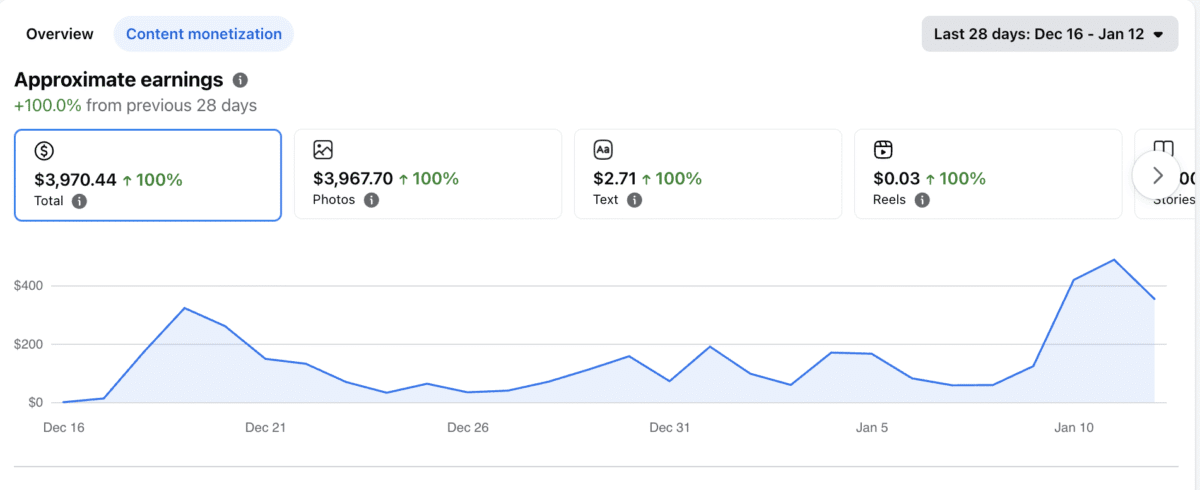
I didn’t expect Facebook to become a meaningful focus going into 2026, but the early trajectory made it hard to ignore.
I put this guide together after talking a few people through what I’ve learned and realizing it was worth organizing in one place.
There’s no startup cost, no product to build, and no sales funnel required.
This isn’t limited to established creators. If you already have an audience, results can come faster. If you don’t, it takes more time, but it’s very doable.
What surprised me is how different Facebook’s distribution is right now. Reach is strong, even for newer accounts, which makes this a viable option for people starting from scratch.
What Facebook Content Monetization Actually Is
Facebook Content Monetization is a single, unified program that pays publishers and individuals based on how their public content performs on the platform.
The key change happened in late 2024.
Before that, Facebook’s monetization efforts were fragmented. Reels bonuses, in-stream ads, and performance bonuses all existed as separate programs, with different rules and different ways to get paid.
Most creators were only monetizing a narrow slice of what they posted.
Facebook Content Monetization rolled all of that into one program.
Today, eligible creators can earn from reels, longer videos, photo posts, and even text posts under the same system, with one dashboard and one set of insights.
Earnings are still performance-based, but they are not a simple “X views equals Y dollars” formula.
In my experience, results are driven much more by engagement than raw impressions. How long people stay on a post, whether they interact with it, and whether it keeps them on Facebook all matter.
Facebook generates billions of dollars in advertising revenue, and it needs a steady supply of engaging, high-quality content to keep people on the platform.
Content monetization is how Facebook shares a portion of that revenue with people who help create that engagement.
Think of it less like YouTube’s RPM math and more like a revenue share tied to meaningful interaction.
How You Qualify for Facebook Content Monetization
The Ways To Wealth has been around since 2016, and my Facebook page had roughly 25,000 followers when I applied.
That said, I hadn’t posted on Facebook in over a year.
Once I learned about Facebook Content Monetization, I applied. Approval was not immediate. In my case, it took about a month.
During the first couple of weeks after applying, I posted inconsistently and experimented. I shared timely content, tested formats, and paid attention to what was already performing well across Facebook.
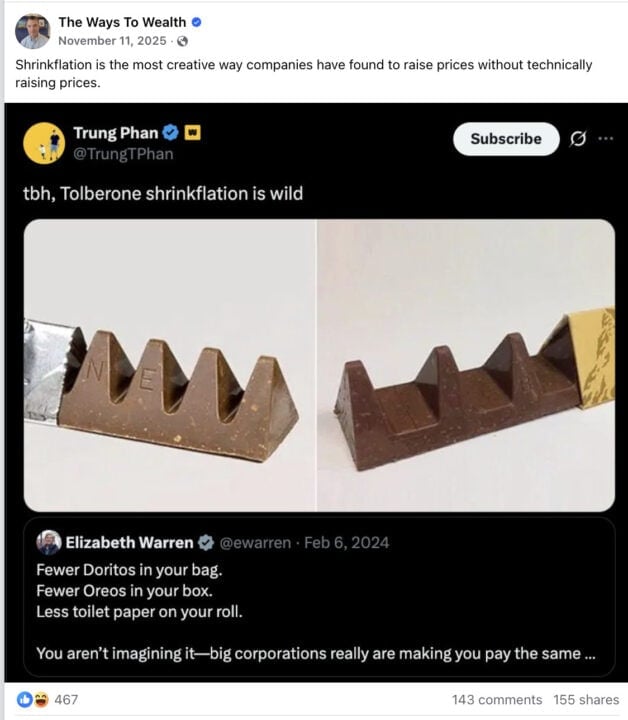
Here’s an example of a post type I went with in the first few weeks, that generated 264,997 views. However, it only generated one net new follower!
The turning point (I believe) was original content.
Once I started posting my own graphics and original takes, in early December below, reach increased further and follower growth followed quickly. And, I was accepted into the Facebook Content Monetization program.
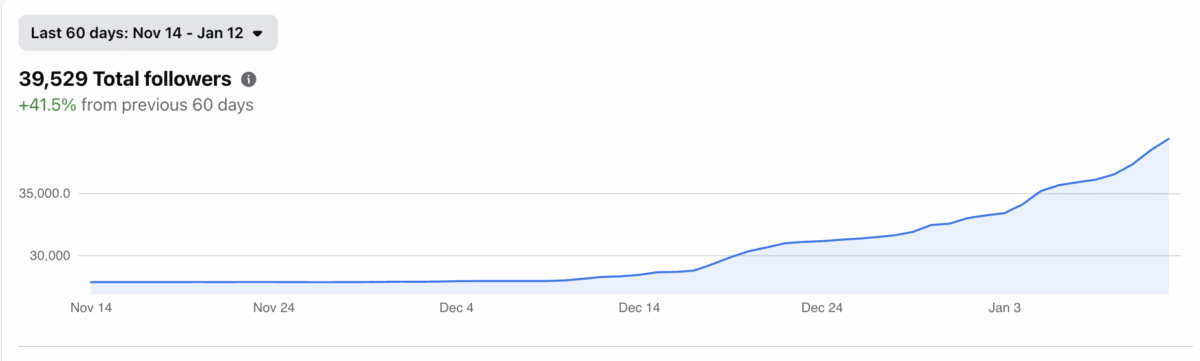
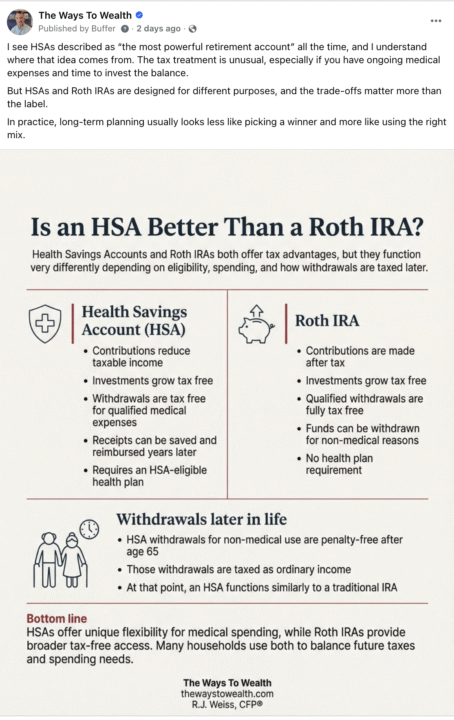
Here’s an example of a piece of original content that generated 365,860 views and resulted in 245 net new followers.
That experience closely matches what Facebook says it values most.
For years, monetization on Facebook was gated by hard thresholds. At one point, you needed 10,000 followers just to apply for certain programs.
Today, access is less about hitting a single number and more about demonstrating consistent, high-quality engagement.
Instead of follower counts, Facebook appears to be evaluating trajectories. Is the content original? Are people spending time with it? Does engagement build over time?
Based on Meta’s official guidance and what I experienced firsthand, qualification now centers on a few core signals:
- Original content. Posts you create yourself, including original visuals, videos, and commentary. Reused or lightly modified content is far less likely to qualify.
- Meaningful engagement. Not just views, but signals that people are actually interacting and spending time with your posts.
- Consistency over time. Facebook appears to favor steady posting and improving performance, rather than short bursts of activity.
- Account health and policy compliance. Pages must follow Community Standards and monetization policies, with no recent violations or restrictions.
- An upward trajectory. Growth patterns matter. Improving reach, engagement, and follower growth over time all send strong signals.
What Actually Drives Earnings on Facebook Content Monetization (Not Just Approval)
When you publish a post, Facebook does not distribute it broadly right away.
It typically shows the post to a small test group first, often people who have engaged with your content before, plus a limited number of users Facebook believes may be interested.
What happens next depends entirely on how that group responds.
If engagement is strong, Facebook expands distribution. If it’s weak, distribution stalls.
That expansion phase is where both reach and earnings are made.
In my experience, it’s common for a post to start earning meaningfully three to five days after it’s published, not within the first hour. Facebook appears to test, observe, and then decide whether to push further.
When a post does break through, earnings can be substantial.
My top-performing post earned $466.67 and continues to generate some revenue, though most of that came during the initial surge.

Why Earnings Feel Uneven Day to Day
Facebook monetization is inherently volatile.
During my time in the program, my lowest full day of earnings was $32.44 (the $12.92 on day one came from only a few hours of activity), while my highest single-day total reached $487.82.
Just a few days apart, I earned $58.85 on January 8 and $487.82 on January 11.
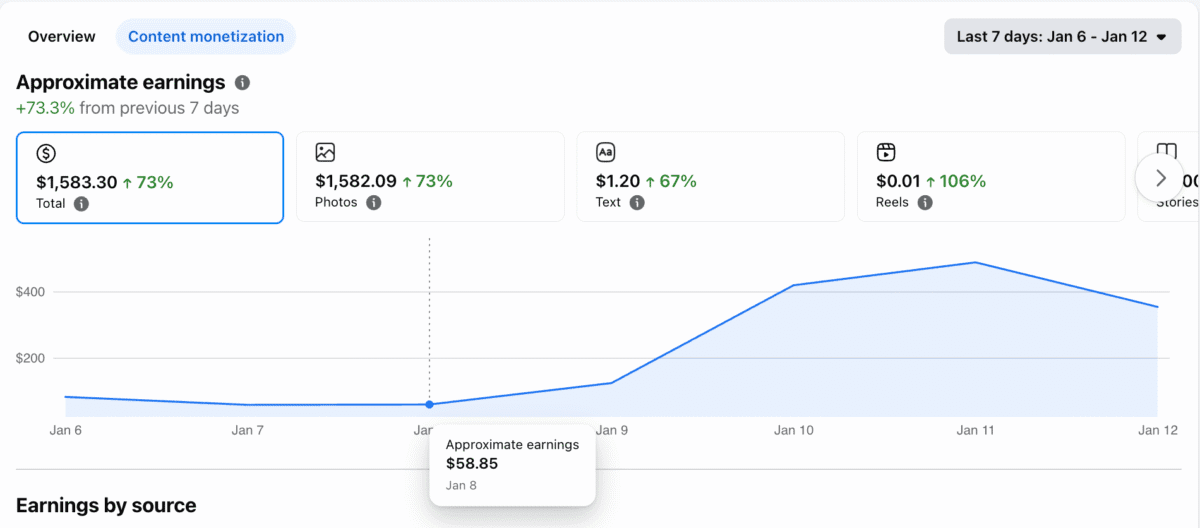
That swing is normal.
Earnings depend on which posts are being pushed, which are peaking, and which are fading.
This is why daily results are a poor signal. What matters more is monthly averages.
Why a Clear Niche Improves Performance
A clear niche matters not because Facebook requires it, but because of how Facebook’s distribution system works.
Your content performs best when the first group of people who see it consistently responds well. That’s much easier when your audience is made up of like-minded people who follow you for a specific type of content.
When early engagement is strong and predictable, Facebook receives clearer signals and is more likely to expand distribution beyond that initial group.
The opposite is also true.
When content jumps between unrelated topics or appeals to different audiences from post to post, early engagement becomes inconsistent.
That makes it harder for Facebook to confidently push content further.
That dynamic is something I experienced firsthand early on.
When I first applied, I was reposting more often and not always adding much original context or value.
Some of those posts performed well in terms of reach, but my follower count barely moved, and I wasn’t accepted into the program.
Engagement existed, but it didn’t compound.
The shift happened when I narrowed my focus and became more intentional about what I posted. I stopped treating Facebook like a place to redistribute content and started using it to publish original explanations and visuals aimed at a specific audience.
Once I did that, two things changed at the same time: follower growth accelerated, and my account was accepted into Facebook Content Monetization.
Why I Tightened My Brand Boundaries Quickly
Early on, I experimented more freely. I reposted screenshots, shared timely content without much added context, and tested formats that were already performing elsewhere.
That helped me understand Facebook’s reach mechanics, but it also clarified something else quickly.
Not all reach is worth building on.
Within a few weeks, I started to define informal brand guidelines for myself.
Nothing written down at first, just a set of filters.
- Would this add value?
- Would someone following The Ways To Wealth actually be better off seeing this?
- Would I want this post to represent the brand a year from now?
That led me away from low-context reposts and toward more original, branded content.
My goal isn’t just engagement in isolation.
It’s attracting people who genuinely want to get better at personal finance.
There’s no shortage of useful ground to cover there, and I’ve found that original explanations and custom visuals perform well without sacrificing quality.
This also matters because Facebook content monetization is only one layer of the opportunity.
Reach creates options. If you build a large, engaged audience around a clear theme, there are multiple paths you can take later depending on your goals.
For example, I drove more than 1,300 visitors back to The Ways To Wealth directly from Facebook.

Many of them become newsletter subscribers. They generate ad revenue immediately. Others convert into affiliate revenue over time.
Other creators take this even further by building more explicit funnels. You’ve probably seen examples like “comment ‘money’ and I’ll send you XYZ,” or free resources delivered via Messenger or email.
From there, some monetize through courses, paid communities, or more direct affiliate offers.
That long-term flexibility depends on trust.
My Day-to-Day Workflow for Facebook Content Monetization
What follows isn’t the only way to use Facebook content monetization. It’s simply how I operate on the platform based on what I’ve learned so far.
One of the things I like most about Facebook right now is that it’s very much a choose-your-own-adventure environment.
You can test different formats, topics, and approaches, and the feedback is relatively fast.
You don’t have to wait months to know whether something is resonating.
That said, this is not an overnight process.
If I were giving someone an honest expectation, I’d say this: be willing to publish at least five posts per day for a minimum of two months before drawing real conclusions.
That volume is what allows patterns to emerge. It’s also what gives you enough data to understand what works, what doesn’t, and what’s worth doubling down on.
With that context, here’s how I actually work with Facebook content monetization day to day.
Posting Volume and Cadence
Initially, I posted around five times per day. As I got more comfortable and saw what consistently resonated, I increased to 10 posts per day. Today, I average between 10 and 15 posts daily.
Other creators post more than that, but many are not producing custom visuals or original commentary. My rule is simple: increase volume only as long as quality stays high.
If you’re starting from scratch, set expectations accordingly. This model rewards consistency and volume over time.
Posting once or twice a day is unlikely to produce meaningful results. In my experience, five posts per day is closer to a minimum, with closer to ten needed to see consistent traction.
Staying Ahead and Scheduling
I try to stay three days ahead at all times.
That usually means having 40 to 50 posts scheduled. This removes daily pressure and keeps output consistent, even when something else demands my attention.
I use Buffer to schedule everything.
It lets me plan in advance and reshuffle easily when something timely comes up. If a topic is especially relevant, I’ll move it to the front of the queue.
Content Mix and Format Choices
Right now, about 90 percent of my posts are photo-based.
That’s not a recommendation for everyone. Some creators do very well with text posts or Reels. The format matters less than whether the content holds attention.
Short posts that take two seconds to consume generally don’t perform as well unless they spark real interaction. I’m always optimizing for posts that make people stop scrolling and stay engaged.
How I Create Content Efficiently
My workflow is AI-assisted, not automated.
I use AI to:
- Generate ideas based on posts that already performed well
- Speed up drafting and iteration
I don’t auto-generate captions end to end.
I often dictate captions using voice input and then refine them. I want people to recognize my perspective over time, not read generic copy.
I also use Canva to customize visuals and keep everything visually consistent. Over time, that consistency has made the content feel recognizable in-feed.
Time Commitment
This takes real time.
Right now, I spend 15 to 20 hours per week on Facebook content monetization, and that’s without fully built systems. It gets easier with repetition, but it’s not passive.
The upside is speed of feedback. You learn very quickly what works, what doesn’t, and where to double down.
At a high level, my operating rules are simple:
- Post consistently
- Keep quality high
- Stay original
- Let results guide iteration
Final Thoughts: How Facebook Content Monetization Fits Into the Bigger Picture
If you step back and look at how people have made money online over the last decade, one trend is clear: platforms are keeping more monetization on-platform.
I started The Ways To Wealth in 2016, when blogs were booming and Google reliably sent traffic to independent sites. And I still believe you can build a profitable site today—I’ve written extensively about how to start a blog and make money blogging.
But it’s also important to acknowledge reality.
Platforms increasingly want creators to publish for them, keep users on them, and get paid by them. That shift isn’t going away.
Against that backdrop, Facebook content monetization stands out as one of the most compelling opportunities I see right now.
It lets you build an audience, earn money, and strengthen a brand at the same time—without needing a product, funnel, or off-platform sales process on day one.
Over time, that reach creates options.
When I look across the broader social media landscape, there are plenty of legitimate ways to make money—but each comes with different tradeoffs.
Here’s how I think about some of the main alternatives right now:
- Amazon Influencer Program. A solid option for people who enjoy creating evergreen product videos. Once content ranks, income can be relatively passive. The downside is that upside tends to be capped lower than other platforms. I break this down in detail in my guide on how to make money with the Amazon Influencer Program.
- TikTok Shop (and TikTok Shop Live). One of the highest-upside opportunities right now, especially for creators who are great on video and comfortable selling products. Live shopping, in particular, is growing fast. The tradeoff is that it’s video-first, performance-driven, and not a fit for everyone. I cover this path in my guide on how to make money on TikTok.
- Snapchat Creator Monetization. Snapchat does offer ways to earn from stories and longer-form content, but the barriers to entry are much higher. You generally need tens of thousands of followers and millions of views before monetization is realistic. More details here on how to make money on Snapchat.
- Instagram. Instagram remains a powerful platform for building a business, especially through affiliates and brand partnerships. That said, organic reach for newer accounts is tougher than what I’m seeing on Facebook right now, and monetization is less centralized. I explain the pros and cons in my guide on how to make money with Instagram affiliate marketing.
- UGC Creation. Creating paid content for brands can be a great way to generate more immediate cash flow, particularly if you’re strong on video. It’s more service-based and less scalable on its own, but it can be a stepping stone into higher-upside models like TikTok Shop. I walk through this path in how to become a UGC creator.
- Twitch. Twitch is far more niche. The creators at the top do extremely well, but it typically requires long hours, live streaming, and a lifestyle-level commitment. It’s less of a side hustle and more of an all-in path. I cover that reality in my guide on how to make money on Twitch.
When I compare all of these options side by side, Facebook content monetization stands out for a few reasons:
- It’s relatively accessible, even for newer accounts
- Organic reach is strong right now if content is genuinely good
- You can monetize multiple formats (photos, text, reels, video)
- Feedback is fast, which makes learning and iteration easier
- It pairs well with long-term brand building, not just short-term income
That doesn’t mean it’s easy or guaranteed. It still requires consistency, experimentation, and a willingness to create a lot of content before things click.
But in the current social media landscape, Facebook content monetization offers one of the best balances I see between effort, upside, and long-term flexibility—which is why I’m spending time here now, and why I think it’s worth serious consideration while the opportunity window is still open.

Very interested in trying the Facebook monetization program
Very easy to get started. Best of luck!