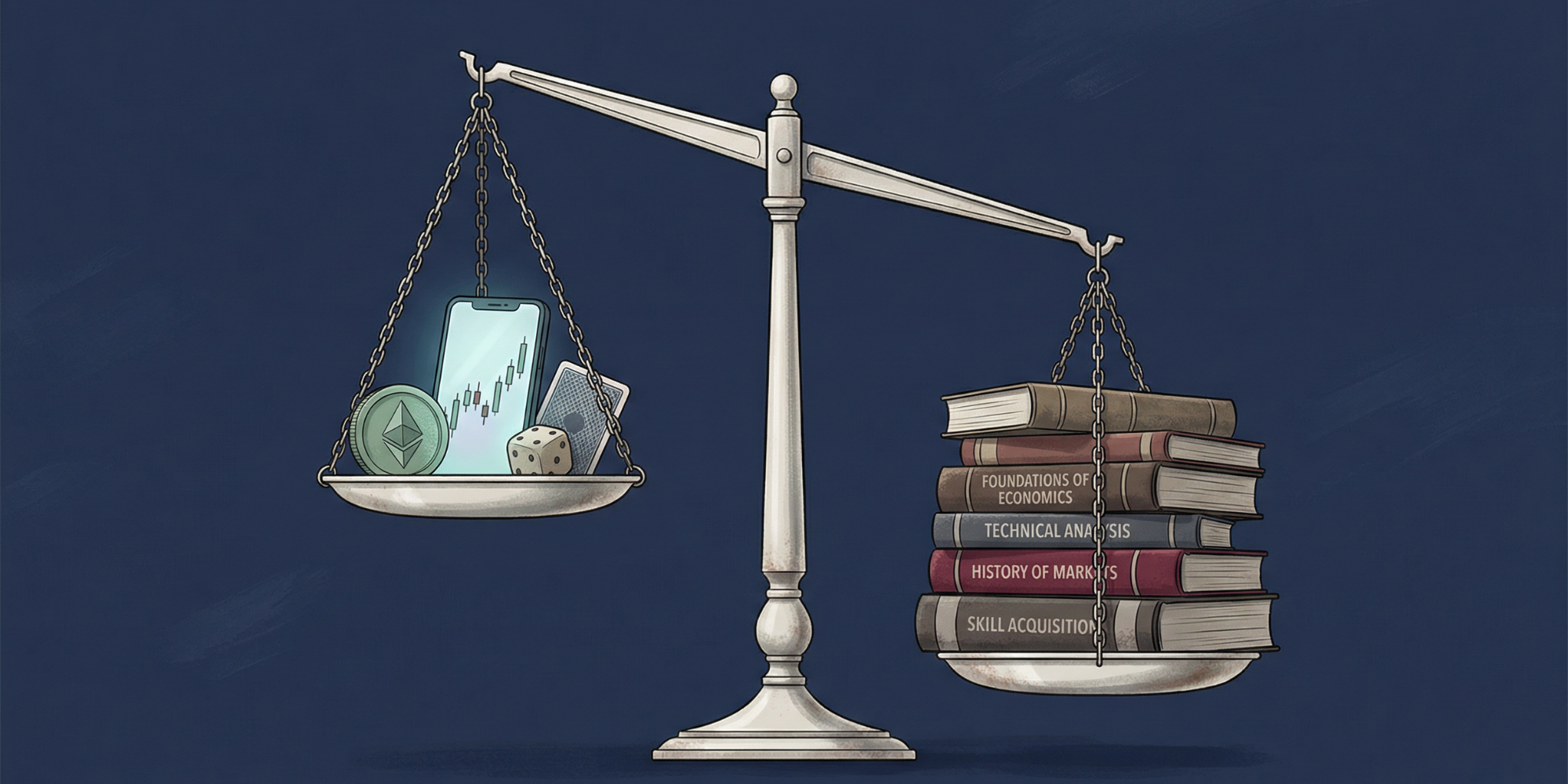
There is a way to dramatically change your financial situation faster than most people expect.
Not overnight, and not on a guaranteed timeline.
There’s no system, product, or secret strategy that reliably turns effort into instant wealth.
And while the standard advice of saving 15% of your income, letting it compound, and becoming a millionaire in 30 years can work, this isn’t that type of guide.
Instead, this article lays out the most realistic path I’ve seen for accelerating your net worth, without shortcuts or false promises.
Here’s what we’ll cover:
- Wealth Is a Process, Not a Moment
- Defining what being “rich” means
- The formula you need to understand to grow your net worth
- The fastest reliable way to increase income
- Investing your income like a millionaire
The strategies outlined in this guide are effective even if you have very little money, assets or resources.
Who Am I?
Who am I to write a guide on how to get rich?
I’m a 40-something CERTIFIED FINANCIAL PLANNER™, dad, and entrepreneur.
I’ve spent the last 20+ years getting my own financial house in order — learning how to invest wisely, save consistently, grow my income, and build businesses.
As a result, I no longer worry about money. I can support my family, and I have the freedom to decide how I spend my time, where I live, and what I work on.
Looking back on my own journey, and studying others who have advanced far beyond where I am today, I’ve noticed consistent patterns in how wealth is actually built.
These are the core truths that can help shorten the distance between where you are now and where you want to be.
Wealth Is a Process, Not a Moment
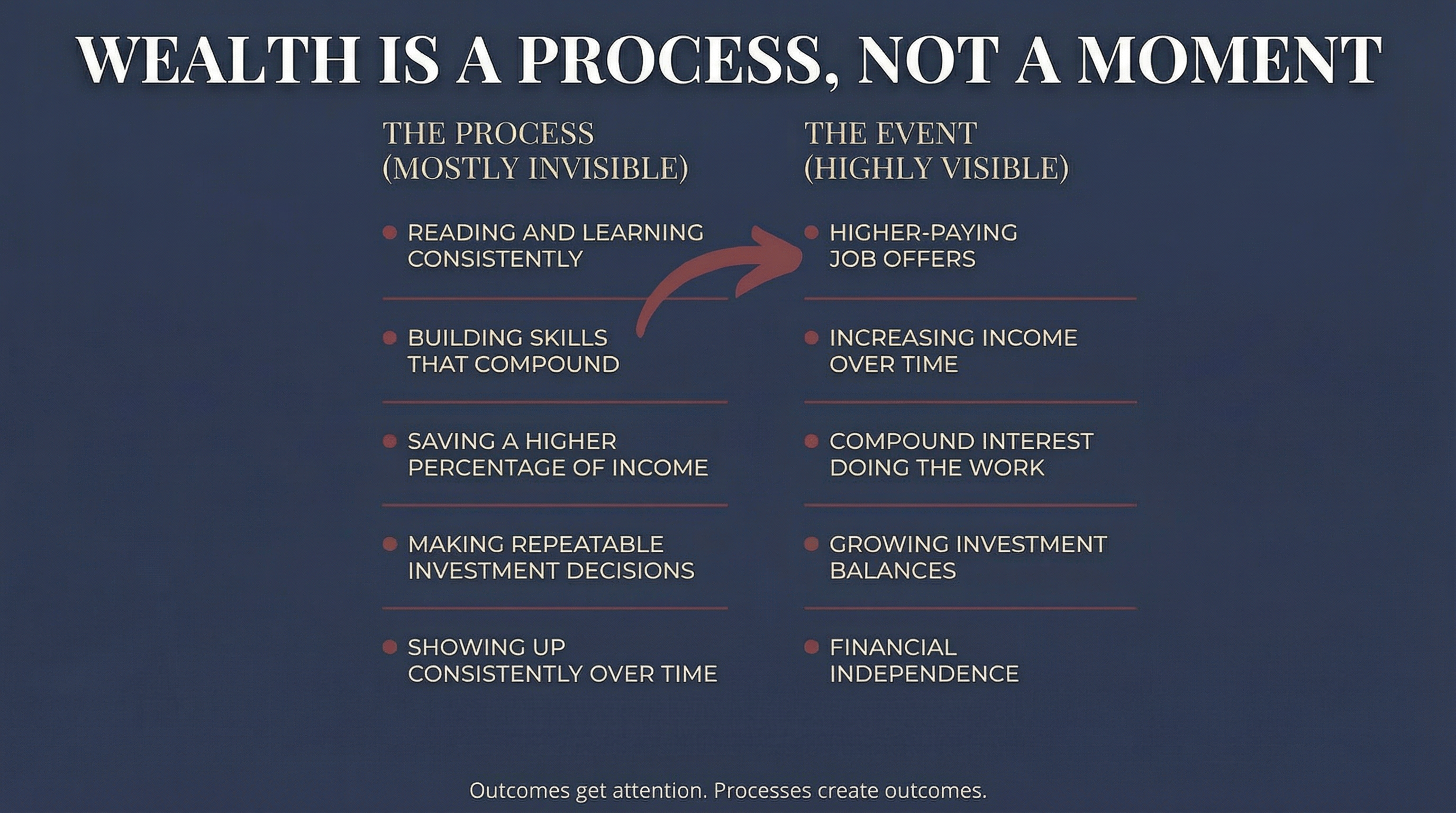
Wealth isn’t created by a single decision. It’s created by a set of behaviors that compound over time.
When people talk about “getting rich,” they focus on outcomes: the business sale, the well-timed investment, the big career win.
Those are events.
What’s invisible is the process that produced them.
A founder selling a business for eight figures gets celebrated as an overnight success.
What’s invisible is the decade before it: learning how to hire, how to sell, how to manage cash flow, how to survive mistakes, and how to build systems that work without them.
The outcome gets attention. The process creates the outcome.
Events are visible and easy to remember. Processes are repetitive, unglamorous, and mostly unseen. But without them, events don’t happen.
This is where most “get rich quick” advice fails. It teaches people to chase outcomes instead of building the behaviors that make outcomes likely.
Summary: Wealth isn’t an event you stumble into. It’s the result of a process you repeat long enough for compounding to take over.
What Does It Mean to Be Rich?
Being a millionaire is concrete. You can say with certainty whether you are one based on your net worth.
Being “rich” is less precise. It depends on your values, priorities, and stage of life.
Some people feel rich earning $10,000 per month with predictable hours and low stress. Others don’t feel financially satisfied until they’ve built a $10 million portfolio. Others want a smaller but reliable income stream that gives them more flexibility with their time.
There’s no single definition that fits everyone. But for most people, the motivation behind getting rich is the same: increased freedom.
Research published in the Journal of Personality and Social Psychology supports this idea. The study found that autonomy, defined as “the feeling that your life, its activities, and habits are self-chosen and self-endorsed,” is a major contributor to long-term life satisfaction.
In practical terms, that means having more control over your schedule, less day-to-day financial stress, and fewer forced tradeoffs.
What freedom looks like depends on where you are financially.
For someone living paycheck to paycheck, it might mean affordable housing, reliable transportation, and enough margin to enjoy small things without anxiety. For someone who already has those basics covered, freedom often means flexibility and optionality.
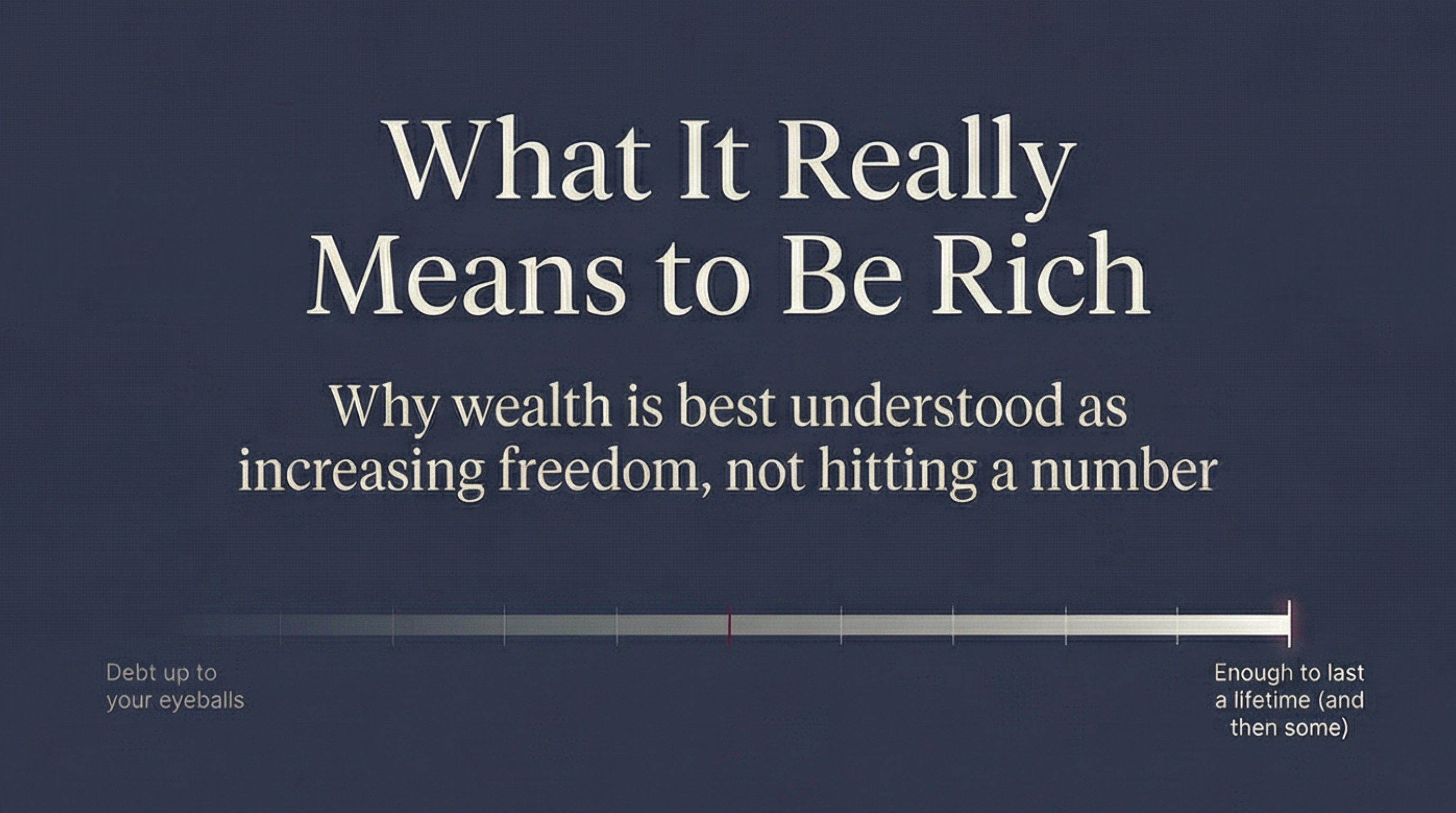
That’s why it’s more helpful to think of wealth as a continuum rather than a single destination.
On one end are people whose decisions are constrained by high-interest debt and constant stress. On the other are people with enough resources to support their lifestyle long term, even when things don’t go as planned.
The goal isn’t to hit a specific number. It’s to consistently move from left to right.
In most cases, moving right increases your options. And in most cases, having more options leads to a greater sense of control over your life.
Paying off that debt doesn’t make you rich. But it does remove a major constraint. And removing constraints is often the fastest way to feel richer before your net worth changes much.
Summary: Feeling rich isn’t about hitting a number. It’s about making decisions that steadily increase your freedom and reduce unnecessary constraints.
The Get Rich Quick Formula You Need to Understand

Benjamin Franklin said:
“There are two ways to increase your wealth. Increase your means or decrease your wants. The best is to do both at the same time.”
Building wealth comes down to a simple relationship: the gap between what you earn and what you spend.
The wider that gap, the more flexibility you have.
For some people, the best use of that gap is paying down debt. For others, it’s investing or reinvesting in skills that increase future income. The right choice depends on your situation.
Early on, widening the gap often starts with saving money. Cutting spending is usually faster and more controllable than increasing income, especially in the short term. But saving only works if high-interest debt isn’t undoing your progress.
High-interest debt is different from other financial obligations.
Carrying a credit card balance at 18–25% interest creates a guaranteed drag on your finances. A meaningful share of your effort goes toward interest instead of forward progress.
Trying to build wealth while carrying high-interest debt isn’t impossible, but it’s inefficient. Much of your financial energy goes into standing still.
That’s why, for many people, addressing high-interest debt is one of the most impactful early steps. Paying it off doesn’t make you rich. It removes a major constraint and improves your ability to make better decisions going forward.
Progress also matters psychologically.
Research on behavior change shows that early, achievable wins make long-term change more likely. That’s why methods like the debt snowball can work well for some people, even if they aren’t mathematically optimal. Consistency matters more than optimization.
The same principle applies to saving. Specific, short-term goals tend to work better than vague ones. Cutting grocery spending for a month is more actionable than trying to “spend less” in general. Small steps still move you forward.
Beyond habits, there are also one-time decisions that permanently reduce future spending. Lowering insurance costs, refinancing expensive debt when appropriate, or avoiding lifestyle inflation can improve your finances without ongoing effort.
Long-term research supports this approach. In The Millionaire Next Door, Thomas J. Stanley and William D. Danko found that most millionaires weren’t extreme earners. They were disciplined about managing cash flow and living below their means over long periods of time.
“They know that planning, budgeting, and being frugal are essential parts of building wealth, even for very high-income producers. Even high-income producers must live below their means if they intend to become financially independent. And if you’re not financially independent, you will spend an increasing amount of your time and energy worrying about your socioeconomic future.”
Summary: Wealth isn’t built through shortcuts. It’s built by widening the gap between income and expenses in ways you can sustain. For many people, that starts with eliminating high-interest debt and creating room for better decisions over time.
The Fastest Reliable Way to Increase Income
Saving money allows you to quickly widen the gap between your income and expenses. But if you want to get rich, you need more than an average income.
You need to quickly become a high-earner. It’s not easy, but it’s possible.
In this section on making money (which is by far the most important) we’ll cover:
- What is money?
- The second formula you need to understand.
- How to increase your value and business skills.
- A 10-year path to overnight success.
What Is Money?
If you want to make a lot of money, it’s first important to understand what money is and isn’t. This might sound simple, but many people get it wrong.
In its most basic form, money is a medium of exchange.
Imagine operating in a society without money. Say you were a potato farmer and you wanted eggs. To get eggs, you’d need to go find a chicken farmer and ask the farmer to trade his eggs for your potatoes.
Now, say that farmer doesn’t want potatoes; he wants wheat to bake bread. You’d then have to go find a wheat farmer to see if they’d exchange potatoes for wheat. If the answer is “yes,” you’d then have to go back to the chicken farmer and trade your wheat for eggs.
By the way, I hope you worked out an equivalent potato-eggs-bread exchange rate. After all, if the wheat farmer wasn’t in the market for potatoes that day, you might have to give up extra potatoes to convince him to take the deal. That means you’d end up paying a lot more than usual for your eggs.
As you can see, it would be a complicated and highly-inefficient way to do business. Yet, that’s what people actually did before money was invented.
Paul Graham, the founder of the seed capital firm Y-Combinator — who is known for his early-stage investments in companies like Stripe, Airbnb, and Dropbox — said in an essay on wealth:
“The solution societies find, as they get more specialized, is to make the trade into a two-step process. Instead of trading violins directly for potatoes, you trade violins for, say, silver, which you can then trade again for anything else you need. The intermediate stuff — the medium of exchange — can be anything that’s rare and portable. Historically, metals have been the most common, but recently we’ve been using a medium of exchange, called the dollar, that doesn’t physically exist. It works as a medium of exchange, however, because its rarity is guaranteed by the U.S. government.
The advantage of a medium of exchange is that it makes trade work. The disadvantage is that it tends to obscure what trade really means. People think that what a business does is make money. But money is just the intermediate stage — just a shorthand — for whatever people want. What most businesses really do is make wealth. They do something people want.”
Summary: Money isn’t wealth. It’s a tool that makes trade easier. You earn money by creating something other people value, and money simply records that exchange.
The Second Get Rich Quick Formula You Need to Understand
Once you understand what money is, the pattern becomes easier to see.
Money is a medium of exchange. You earn it by doing something people want. But doing something people want, even something valuable, is not enough on its own.
Vincent van Gogh produced extraordinary value. His paintings changed how people see the world. Yet he died poor. The value was there, but during his lifetime, there was no reliable way to turn it into income.
Thomas Kinkade presents the opposite case.
Kinkade was universally loathed by art critics, and in recent years scientific research has found his work to be objectively “bad.”
However, he made more money from his art than every other artist in the world combined. (He eventually lost it all, but you can’t deny his ability to make money. Check out the book Billion Dollar Painter.)
The difference wasn’t talent or effort. It was conversion.
Van Gogh maximized value without monetization.
Kinkade maximized monetization with modest value.
Durable wealth comes from focusing on both sides of the equation:
Making Money = Value × Ability to Monetize That Value
The work isn’t choosing one side. It’s improving both at the same time. Increase the value you provide, and learn how to consistently turn that value into income.
Summary: To grow your wealth, increase both the value you provide and your skill at turning that value into money.
Increasing Your Value
“Increase your value” sounds abstract until you look at how it happens in practice.
People who earn more over time tend to get there the same way. They become unusually good at something other people need, and they stay with it long enough for that advantage to compound.
The work is rarely glamorous. It’s repetitive. It involves learning where you’re weak, fixing it, and doing the same task again with slightly better judgment.
Over time, that judgment becomes hard to replace.
This is why early effort often looks unrewarded. Skills don’t pay linearly. They pay later, when experience begins to differentiate you from everyone else who stopped early.
Most people try to increase income by doing more things. The people who pull away tend to do fewer things, better.
That’s what “be so good they can’t ignore you” actually means. Not perfection. Not passion. Competence accumulated to the point where it creates leverage.
Value, in this sense, isn’t potential. It’s usefulness. It shows up when someone prefers your work to the next available alternative.
That preference is what creates demand.
Demand is what makes monetization possible.
And while monetization matters, value comes first. Without it, income is fragile. With it, income tends to follow, even if imperfectly.
That’s why one of my favorite books on making money is Mastery by Robert Greene. It has nothing to do with tactics, stock picks, or shortcuts. It’s about committing to a craft long enough for skill to compound into real leverage.
Developing Your Business Acumen
The ability to turn value into money is a skill.
Like most skills that matter, it isn’t innate. It’s learned through repetition, feedback, and adjustment.
That’s why it’s useful to think of any attempt to earn more money as practice. Asking for a raise. Taking on extra work. Starting a side project. None of these are final moves. They’re reps.
If you’ve never earned more than $30,000 a year, the goal isn’t to leap to $100,000 overnight.
A more useful starting point might be figuring out how to earn an extra $200 this month. That could come from working more hours, picking up a short-term job, or testing a small side hustle.
The specific path matters less than the act of starting.
What matters is engagement. Monetization improves through use.
Inaction is usually more damaging than imperfect action. You learn little by waiting for the right idea. You learn a lot by trying something that mostly works, then adjusting.
Failure is part of the process. Not every attempt produces results, and that’s expected.
I started 13 websites before building The Ways To Wealth. Some failed outright. Others went nowhere. A few worked. Each one taught me something I couldn’t have learned in advance.
This pattern shows up repeatedly when you look closely at people who’ve built successful businesses or careers. The early failures aren’t detours. They’re where the skill was formed.
Henry Ford put it plainly:
Failure is simply the opportunity to begin again, this time more intelligently
So, start doing something — anything — to increase your income. If it doesn’t work, try something else.
Don’t be afraid to step outside your comfort zone, and don’t try to go from $0 to $100,000 overnight. Start where you are and take small steps to get to the next level.
That’s how skills and confidence (and wealth) are built.
My 10-Year Path to Overnight Success
Before I started The Ways To Wealth, I launched 13 other websites. I also freelanced in digital marketing while working full-time.
Early on, I looked like everyone else. I was a freelance writer in the personal finance space. I managed Google and Facebook ads for local businesses. Nothing about it was distinctive.
Things changed when I specialized.
Unbounce had just launched, and at the time it was the best landing page software on the market. I focused on designing landing pages specifically for that platform.
It wasn’t a massive niche, but when someone wanted a high-quality Unbounce page, they knew where to go.
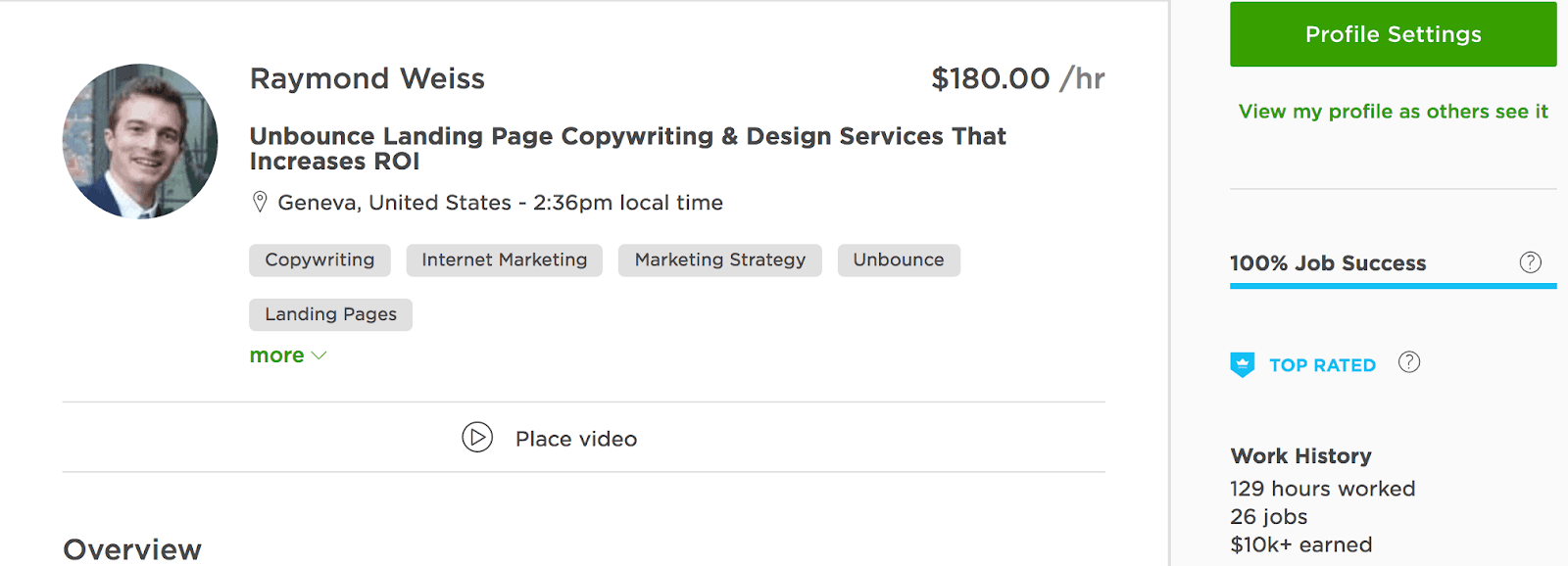
For a period, I was the top freelancer on Upwork in that category. I charged $180 per hour and rarely had to apply for jobs.
That opportunity wasn’t obvious at the start.
I only saw it after spending time inside the digital marketing industry. I had to learn how campaigns worked, what businesses struggled with, and where results actually came from. Only then did it become clear what people were willing to pay for.
This is an important point. Making money isn’t just about being good at a task. It’s also about learning how value moves through an industry and where monetization actually happens.
I couldn’t charge premium rates on day one. That came later, after years of working at lower rates while building skills, context, and judgment.
I freelanced on the side while working full-time, steadily adding capabilities. I learned how to run ads, write copy, design landing pages, and analyze results. Over time, those skills began to reinforce each other.
Eventually, it made more sense to apply them to my own business instead of someone else’s. That’s when I started this site.
When you build your own business, you’re not just increasing income. You’re building an asset. And for business owners, there’s another variable that matters: the market itself.
Markets grow or shrink. When you’re in a growing market, you benefit simply by staying in it. Demand increases without requiring proportional increases in effort.
So for business owners, the equation expands:
Making Money = Value × Ability to Monetize That Value × Market Growth
This is where growth can feel sudden. Not because it’s fast, but because several years of skill-building and positioning finally align with a growing market.
That alignment creates what looks like rapid success from the outside.
But the sequence matters.
Before you can start a business that scales, you need skills that create real value. You need enough understanding of an industry to recognize where demand exists and how it’s changing. And you need experience turning value into income, even in small amounts.
It’s tempting to skip ahead to the “start a business” stage. To ignore saving, ignore skill-building, and ignore how customers actually behave.
But those steps aren’t optional. They’re the foundation.
Summary: Lasting wealth tends to follow a pattern. Build valuable skills. Learn how to monetize them. Then apply both in a growing market. When those pieces come together, growth can feel sudden, even though it was years in the making.
Investing Your Income
In 2008, Tim Ferriss, author of the popular 4 Hour book franchise and host of the podcast “The Tim Ferriss Show,” got to ask Warren Buffett a question at the annual Berkshire Hathaway shareholder meeting.
As he writes on his blog, his question was:
“If you were 30 years old and had no dependents but a full-time job that precluded full-time investing, how would you invest your first million dollars, assuming that you can cover 18 months of expenses with other savings? Thank you in advance for being as specific as possible with asset classes and allocation percentage.”
Buffett replied:
“I’d put it all in a low-cost index fund that tracks the S&P 500 and get back to work.”
What’s notable isn’t just what Buffett recommended, but what he left out.
There was no talk of beating the market, no complex strategies, no real estate, no stock picking. Just a simple instruction to track the market and focus on earning.
That advice reflects a basic reality.
Over long periods, the vast majority of professional investors fail to outperform the market after fees.
For most people, especially those with strong earning potential, the highest-return use of time isn’t trying to outsmart the market. It’s increasing income and investing consistently.
Index fund investing isn’t exciting, but it’s effective. When rising income is paired with a high savings rate, the results compound. Not only does your portfolio grow, but the amount you’re able to invest grows as well.
The goal of investing isn’t excitement. It’s maximizing after-tax, after-fee returns. If your employer offers a 401(k) match, that’s usually the best place to start. If not, a traditional or Roth IRA with a low-cost provider can accomplish the same objective.
Simple, boring strategies tend to work because they leave room to focus on the part you actually control: earning more and saving more over time.
Summary: Build wealth by keeping your spending in check, steadily increasing your income, and investing the difference consistently. You don’t need a large amount of money to start. Even small, regular investments in low-cost index funds can compound meaningfully over time if you start early and stay consistent.
How to Get Rich Fast: Final Thoughts
There is no get-rich-quick scheme that works. There is no secret investment opportunity that will change your financial situation overnight. Some people get lucky. Lottery winners exist. But luck isn’t a strategy, and it’s not how wealth is built.
What is possible is moving much faster than most people expect, not by chasing shortcuts, but by focusing on the right things in the right order.
You can move from constant financial stress to real flexibility. From reacting to bills to making deliberate choices about how you spend your time, where you live, and what you work on.
Just as important, you can build a career or business that’s both financially rewarding and personally fulfilling.
The work isn’t easy. It takes patience, focus, and consistency. But the time will pass either way. The difference is whether you use it to build leverage or let it drift.