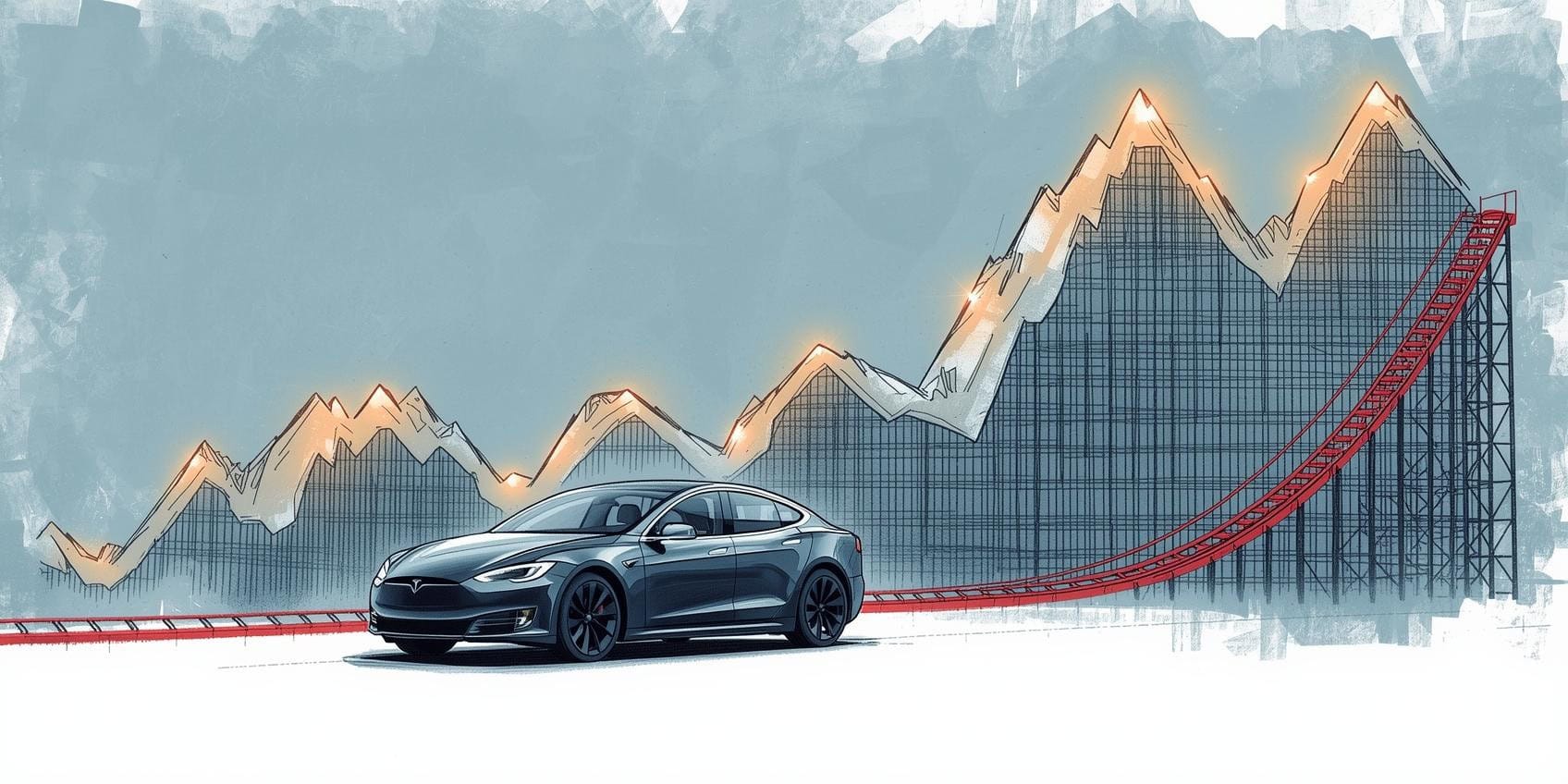
Back in 2012, I bought 190 shares of Tesla at just over $26.
What happened after that order taught me more about investing than any book, podcast, or class ever could.
Fast forward to November 2025.
After a 5-for-1 split in 2020 and a 3-for-1 split in 2022, those 190 shares would now be 2,850 shares (spoiler alert: I sold). With Tesla trading around $420 today (and no Elon Musk pun intended), my original $5,000 investment would be worth about $1.19 million.
It is a wild number to look at. But it also reinforces the lesson this experience taught me early on.
Holding a single, highly volatile stock over a decade requires a temperament very few people naturally have. I certainly did not.
In this post, I will share what this experience taught me about investing, why picking individual stocks is far harder than it looks, and and how I invest today.
What Happened After I Bought Tesla in 2012
I have a personal rule that says it’s OK to make an occasional bet with 5-10% of my available investment funds.
It’s hard, next to impossible even, to beat the market by picking individual stocks, so the bulk of my savings goes toward maxing out my 401(k) and IRA and into “boring” but relatively predictable investments like index funds.
This was also one of the first YouTube videos I ever recorded for my channel. The numbers in that video will be off compared to today, but the ideas are still highly relevant.

But I enjoy investing and thinking about which companies will play a big role in the future, so this rule gives me a way to keep personal finance fun without gambling my family’s future.
Back on August 7th, 2012, I placed a small bet on Tesla and bought about $5,000 worth of stock in the company.

I couldn’t have timed things better.
Since I don’t make very many of these types of bets, this was one of the few individual stocks I owned at the time. That made it fun and easy to track, as it wasn’t just a little outlier in my portfolio of dozens of holdings.
I still remember the feeling when the stock would jump 10% in a matter of hours and I would calculate how much my net worth had increased.
Fun stuff!
However, while I’m extremely grateful I made the decision to invest in the company, I was surprised by how mentally taxing it was to hold a stock like this.
What started out as a little bet quickly transformed into a solid chunk of my net worth.
And the price volatility was stressful.
While the overall trend was up, there were plenty of downturns. And when you hold a stock like Tesla during a period like this, you’re checking it multiple times a day (at least I was).
There’s a behavioral science principle called loss aversion which says that losses loom larger than gains.
I definitely experienced that phenomenon. Don’t get me wrong: watching the stock climb felt great. But watching it drop? That hurt. I went to bed on more than one night thinking about my losses.
Another behavioral science principle is the wealth effect, which says that spending increases when someone’s portfolio value increases.
I remember experiencing that as well; I started justifying expenses I probably wouldn’t have made otherwise because my investment was doing so well.
Finally, one more behavioral principle I got to witness first hand was overconfidence bias. I actually started to think I had a skill for investing; that maybe it was even something I should do as a career.
Three Lessons I Learned About Investing
I realized pretty quickly that I wasn’t cut out to hold a stock like this for the rest of my life. And judging by the volatile trading activity, very few people are either.
I held on for 14 months, finally cashing out with a return of over 500%.

And while I’ve certainly wrestled with a bit of “what if, should have, could have” over the years, I’m actually not that depressed about selling early.
After all, if you would have told me, 14 months prior to buying those shares, that I would have scored a 500% ROI on a single investment?
I would have taken that deal in a heartbeat.
But another reason I’m not as disappointed about selling as you might imagine is because this experience laid a foundation for building wealth for years to come. The money I made was nice (really nice), but what I learned about myself and about investing is invaluable.
Lesson #1: Buying a Stock Is Easy. Holding It Is the Real Challenge
Investing in individual stocks requires making two really good decisions: when to buy and when to sell. And both of these decisions take a combination of luck and skill to make.
My purchase of Tesla shares wasn’t the result of a deep dive into the company’s financial statement. I simply thought the company was going to be big in the future and invested in it.
And this is from someone who has read every single Warren Buffett biography, many of Buffett’s recommended books and all of his shareholder letters. I had probably read Warren Buffett’s quote, “Our favorite holding period is forever,” dozens of times.
And I even remember telling people that I planned to hold the stock for the long-term.
But one day, after some more major price fluctuations, I decided to put a stop order in at a certain price. And a few days later, it triggered.
Lesson #2: Knowing the Right Strategy Is Not the Same as Following It
Buying and holding an individual stock is hard for the average investor.
Say I didn’t sell back in October of 2013. It’s very likely I would have sold sometime soon after.
Most of the massive gains Tesla has experienced since then came during the last few months of 2019 and early 2020. So, I would have needed to hold on for another seven years — a period during which there were lots of price fluctuations and tons of uncertainty about the company’s future, but not exactly much in the way of long-term growth.
The bigger factor though is how my life changed over that time. Three kids, two moves, career changes, a house, a house renovation, and plenty of medical bills; life events like these play an important role for a smaller investor.
Large investors don’t have to think about things like liquidating their holdings to pay for unexpected medical bills. But for everyday people like you and me, something like that can certainly be a factor in our investment returns.
Since the majority of people don’t carry a fully-funded emergency fund, it’s often stocks that get liquidated at inopportune times.
And selling at the wrong time is never ideal.
Lesson #3: Your Savings Rate Matters More Than Your Rate of Return
I like to think of personal finance as a game. The end of the game is becoming financially independent — getting to the point where your income from investments exceeds your expenses.
And that means winning the game requires winning over decades, not months or years.
The math is pretty simple. You have four factors:
- How much you make.
- How much you save.
- The rate of return of your savings.
- How much time you let your investments compound.
If you have read even one investing book, you have seen the chapter on compound interest. It usually starts with a simple example.
Imagine your household earns $10,000 a month. You save 10 percent of your income, which comes out to $1,000 a month. If your investments earn 10 percent a year, you end up with about $760,000 after twenty years.
Not bad. But maybe you want to see what happens if you do a little better.
Run the numbers again. Keep the savings at $1,000 a month, but assume a 12 percent return instead of 10 percent. Now you end up with about $1,010,000 after the same twenty years.
A larger number, but not a different life.
And here is the part most people miss.
Earning two percentage points more than the market for twenty straight years is almost unheard of. Only a handful of professional investors have ever done it. Not the average person saving for retirement. Not part-time stock pickers. A very small group of pros. Most people who try never come close.
But your savings rate is something you do control.
Change the example. Instead of trying to boost your returns, increase your savings rate from 10 percent to 15 percent. That means saving $1,500 a month. Stick with the baseline 10 percent return and you end up with about $1,140,000 after twenty years.
Increase your savings rate to 20 percent, or $2,000 a month, and you finish with roughly $1,520,000.
Same market. Same twenty years. No need to outguess anyone.
The math is simple. Saving a little more often beats trying to outsmart the market. Compounding rewards consistency, not brilliance.
How I Invest Today
Those lessons stayed with me. They did not turn me into a perfect investor, but they did change how I invest. Today my approach reflects what I trust myself to actually stick with, not what looks best on paper.
I still keep a small allocation in things that interest me. I hold a little crypto inside a self-directed IRA through iTrustCapital. It is less than 5 percent of my net worth, and that is intentional. Crypto inside an IRA has unique pros and cons, which I explain in my guide on how crypto IRAs work, but it is not the right fit for everyone.
The other 95 percent is simple.
Most of my portfolio is built around broad index funds.
I use M1 Finance for a large portion of it because their automated portfolios give me something very close to a robo-advisor but without the management fee. I have used them for years and the experience has been steady and low maintenance.
If you want to learn more, you can read my M1 Finance review.
I also hold some funds at Vanguard, mainly to keep things organized. But whether it is M1 or Vanguard, the idea is the same. Own diversified funds. Automate contributions. Stay out of the way.
This is the same long-term approach I outline in my guide to retirement investing, which shapes much of my own philosophy.
The biggest benefit of this approach has been psychological. I do not check my accounts every day. I do not feel the need to react to headlines. I look at my portfolio maybe once a quarter. Almost all my attention goes to my savings rate.
Most of my saving happens through a solo 401(k) for my business.
I contribute as much as allowed and invest that money across simple index funds.
This structure takes emotion out of the process, which has helped me stay calm during volatile periods.
I know plenty of people who panic sold during the last few chaotic years. Sticking with a simple plan helped me avoid that, and I expect it will do the same if we go through a stretch like the early 2000s when the market had three down years in a row.
At forty years old, I still have a long runway. The best thing I can do is keep saving, keep investing, and keep things boring. It is the strategy I trust myself to follow through every market cycle, which makes it the one most likely to work.